


Gold trading step by step: institutional guide 2026
- Shannon B
- Mar 19
- 8 min read


Institutional and high-net-worth investors face mounting pressure to diversify portfolios amid market volatility and geopolitical uncertainty. Gold has emerged as a critical asset class, with global central banks adding 1,136 tonnes in 2022 alone. Yet trading gold effectively requires navigating complex instruments, regulatory frameworks, and risk controls. This guide delivers a structured, step-by-step approach to gold trading in 2026, equipping you with actionable strategies to integrate gold into diversified portfolios while managing exposure through transparent, disciplined execution.
Table of Contents
Key takeaways
Point | Details |
Multiple trading methods | Futures, ETFs, physical bullion, and OTC markets each offer distinct liquidity, cost, and ownership profiles for institutional access. |
Structured trading process | Success requires selecting regulated brokers, completing compliance, funding accounts, setting risk limits, and practicing before live execution. |
Optimal allocation range | Research supports 5-18% gold allocation to enhance risk-adjusted returns without excessive volatility. |
Advanced 2026 strategies | Algorithmic trading on Micro Gold Futures and on-chain XAU/USD via blockchain reduce costs and improve settlement speed. |
Risk management essentials | Position sizing at 1-2% per trade, stop-losses, and volatility filters protect capital while capturing upside. |
Understanding gold trading methods for institutional investors
Institutional investors access gold primarily through futures contracts, ETFs, physical bullion, and OTC markets, with futures dominating due to liquidity. Each method presents trade-offs between convenience, cost, ownership, and operational complexity. Selecting the right instrument depends on your portfolio objectives, capital deployment timeline, and risk tolerance.
Futures contracts trade on regulated exchanges like COMEX, offering deep liquidity and standardized 100-ounce contracts. Leverage amplifies both gains and losses, making futures ideal for active traders seeking price exposure without physical delivery. Settlement occurs daily through margin accounts, requiring robust risk controls.
ETFs such as SPDR Gold Trust provide convenient exposure through equity-like trading. You gain indirect gold ownership backed by physical reserves held in vaults. Annual fees range from 0.2% to 0.5%, and tracking errors occasionally diverge from spot prices. ETFs suit investors prioritizing liquidity and simplicity over direct ownership.
Physical gold delivers tangible ownership through allocated bars or coins stored in secure vaults. Premiums over spot prices typically range from 3% to 10%, depending on product type and dealer markup. While storage and insurance add ongoing costs, physical holdings eliminate counterparty risk and provide ultimate control.
OTC markets facilitate bespoke institutional transactions outside exchanges, accommodating large volumes and customized terms. Liquidity varies by counterparty and market conditions. Banks and dealers quote bid-ask spreads, which widen during volatility. OTC suits institutions executing strategic, high-volume trades.
Comparing types of gold trading reveals key differences:
Futures offer maximum leverage and liquidity but require active management and margin maintenance
ETFs balance accessibility with modest fees, ideal for passive allocators seeking diversification
Physical gold provides ownership security at the cost of higher premiums and storage logistics
OTC markets enable flexible, large-scale transactions but demand strong counterparty relationships
Understanding these nuances positions you to match trading methods with portfolio goals. For insights on how gold compares to other precious metals, explore gold vs. other metals insights.
Step-by-step process to start trading gold
Launching gold trading operations requires systematic preparation across regulatory compliance, account setup, capital allocation, and risk framework development. Following this sequence ensures you enter markets with clarity and control.
Select a reputable, regulated broker offering gold instruments aligned with your strategy. Platforms like Pepperstone and IG provide FCA regulation, competitive spreads, and institutional-grade execution. Verify licensing, segregated client funds, and platform stability before committing capital.
Complete Know Your Customer (KYC) verification by submitting identification documents, proof of address, and entity registration details. Regulatory compliance protects both parties and ensures legal trading operations across jurisdictions.
Fund your account with initial capital meeting broker minimums, typically ranging from $500 to $5,000 for retail platforms or higher for institutional accounts. Understand margin requirements, leverage limits, and withdrawal procedures before transferring funds.
Establish risk management rules governing position sizing, stop-loss placement, and maximum daily loss thresholds. Industry best practice limits risk to 1-2% of account capital per trade, preserving longevity through inevitable drawdowns.
Develop a comprehensive trading plan documenting entry criteria, exit strategies, position sizing formulas, and performance metrics. Define whether you pursue trend following, mean reversion, or event-driven strategies based on market analysis and time horizon.
Practice on demo accounts simulating live market conditions without financial risk. Test your plan across various scenarios, refine execution processes, and build confidence before deploying real capital.
Pro Tip: Allocate at least 30 days to demo trading, executing a minimum of 50 trades to validate your strategy across different market conditions and identify psychological patterns affecting decision-making.
Step-by-step gold trading preparation separates disciplined investors from reactive speculators. Rushing through setup invites costly mistakes, while methodical preparation builds sustainable trading operations.
Risk management and portfolio allocation strategies for gold trading
Optimizing gold exposure within diversified portfolios requires balancing diversification benefits against concentration risks and volatility. Empirical research and institutional practice converge on allocation ranges that enhance risk-adjusted returns without excessive single-asset dependence.

Optimal gold portfolio allocation is approximately 18%, improving risk-reward compared to traditional 60/40 portfolios, while the World Gold Council suggests 4-15% allocation. Historical analysis shows allocations between 5% and 15% reduce portfolio volatility during equity drawdowns while maintaining upside participation during bull markets. Exceeding 20% introduces liquidity constraints and amplifies gold-specific risks.
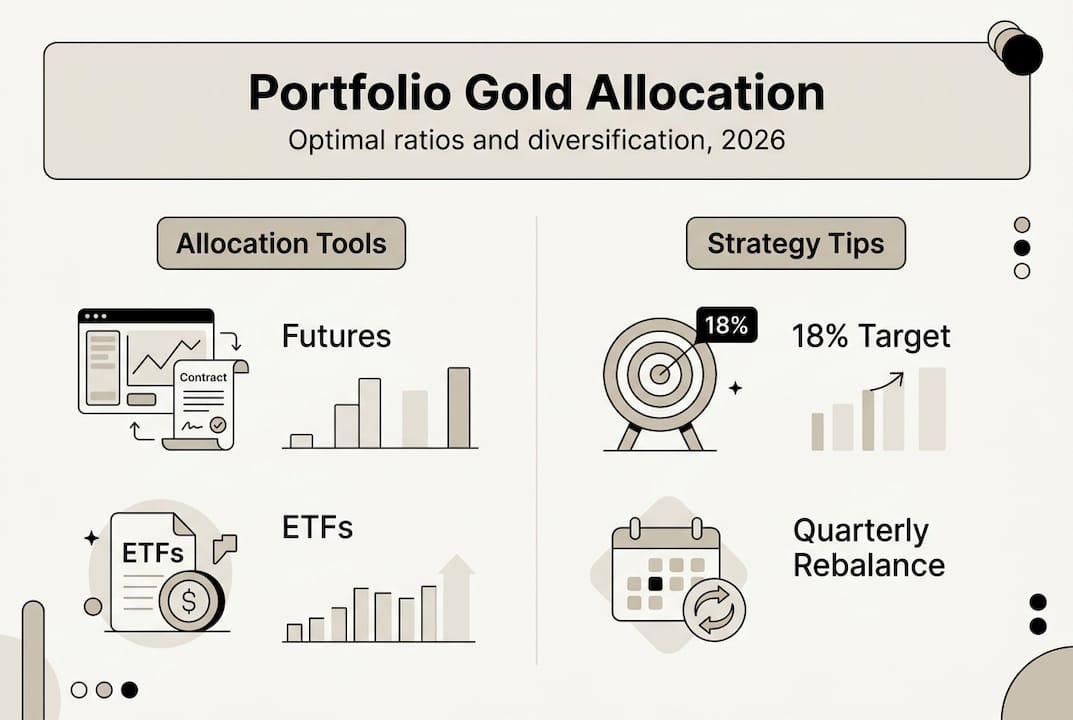
Over-concentration above 15% creates several challenges. Gold lacks yield, generating no income during holding periods. Liquidity deteriorates for physical holdings during market stress. Price volatility increases portfolio swings without proportional diversification gains. Balancing gold with equities, fixed income, and alternative assets optimizes the efficient frontier.
Risk mitigation tactics essential for gold trading include:
Position sizing limits capping individual trades at 1-2% of total capital, preventing single losses from materially impairing portfolios
Stop-loss orders automatically exiting positions when prices breach predetermined thresholds, crystallizing manageable losses before escalation
Volatility filters pausing trading during extreme market conditions when spreads widen and execution quality deteriorates
Diversification across gold instruments, blending futures for tactical exposure, ETFs for liquidity, and physical holdings for strategic reserves
Gold’s role varies by geography and economic context. In developed markets with stable currencies, gold functions primarily as a safe haven during crises, rallying when equities decline. In emerging markets facing currency devaluation or political instability, gold serves as a wealth preservation tool and inflation hedge. Tailoring allocation to regional risk profiles optimizes diversification benefits.
Balancing physical gold, ETFs, and futures within your gold portfolio risk management framework distributes operational, counterparty, and liquidity risks. Physical gold eliminates counterparty exposure but adds storage costs. ETFs provide liquidity but introduce tracking error. Futures offer leverage but demand active management. Combining instruments creates resilient exposure.
Pro Tip: Rebalance gold allocations quarterly or when positions drift beyond 20% of target weights, maintaining disciplined exposure through market cycles and preventing emotional overreaction to short-term price movements.
For comprehensive portfolio construction guidance, review our gold investment strategy guide.
Advanced trading strategies and nuances to master in 2026
Sophisticated investors in 2026 leverage algorithmic execution, blockchain settlement, and tactical timing to optimize gold trading performance and reduce transaction costs. Mastering these techniques separates institutional-grade operations from retail approaches.
Algorithmic trading on Micro Gold Futures uses breakout strategies with volume and volatility monitoring, while on-chain XAU/USD via Solana offers zero spread and non-custodial benefits with fast settlement. Micro contracts sized at 10 ounces reduce capital requirements while maintaining exposure. Algorithms monitor volume spikes, ATR expansion, and moving average crossovers to identify high-probability entries.
On-chain gold trading eliminates traditional brokers by tokenizing gold ownership on blockchain platforms. Benefits include instant settlement, transparent pricing without dealer spreads, and non-custodial control of assets. Solana-based XAU/USD pairs execute trades in seconds with minimal fees, democratizing access to institutional-grade execution.
Volatility management around Federal Open Market Committee (FOMC) decisions requires specialized tactics. Price swings intensify during rate announcements, widening spreads and triggering stop-losses prematurely. Experienced traders adjust ATR-based stops to accommodate expanded ranges and delay entries until initial volatility subsides, typically 30 to 60 minutes post-announcement.
Cost factors significantly impact net returns across trading methods:
Method | Transaction Cost | Annual Holding Cost | Liquidity |
Futures | $0.50-$2.00 per contract | Margin interest 3-5% | Highest |
ETFs | 0.1-0.3% spread | 0.2-0.5% expense ratio | High |
Physical | 3-10% premium | 0.5-1.5% storage/insurance | Moderate |
OTC | Negotiable spread | Minimal | Variable |
Physical premiums range from 3% for large bars to 10% for retail coins, while ETF expense ratios compound annually. Futures avoid holding costs but incur rollover expenses when extending positions beyond contract expiration. Optimizing method selection based on holding period and transaction frequency minimizes total cost of ownership.
Tax and jurisdiction considerations influence after-tax returns. Many jurisdictions classify physical gold as collectibles, taxing gains at higher rates than securities. ETFs structured as grantor trusts pass through tax treatment, while futures receive blended 60/40 long-term/short-term capital gains treatment in the U.S. Consult tax advisors to structure holdings efficiently.
Key operational nuances for 2026:
Monitor geopolitical events and central bank policy shifts driving gold sentiment
Track dollar strength, as gold typically moves inversely to USD
Observe real interest rates, with negative rates historically supporting gold prices
Utilize correlation analysis to time gold additions when equity correlations break down
For deeper exploration of sophisticated techniques, visit our advanced risk management resources and learn how to manage risk in gold investment effectively.
Explore Galami Gold’s institutional gold trading solutions
After mastering gold trading fundamentals and advanced strategies, partnering with a trusted platform accelerates implementation and reduces operational complexity. Galami Gold operates as a physical gold trading platform dedicated to disciplined execution, transparency, and managing risk across well-established supply chains. Our audited, secure physical gold investment options serve institutional investors and high-net-worth individuals seeking diversification and value preservation.

Galami Gold delivers high ROI potential through transparent allocations, allocated storage solutions, and streamlined access to vetted gold sources. Whether you’re building strategic reserves or executing tactical trades, our platform provides the infrastructure and expertise institutional investors require. Explore Galami Gold’s physical gold trading platform to discover how we support your portfolio objectives with integrity and efficiency.
Frequently asked questions
How do I choose the best gold trading method for my portfolio?
Compare futures, ETFs, and physical gold based on your liquidity needs, cost tolerance, and desired ownership level. Futures offer maximum liquidity for active traders, while physical gold provides direct ownership at higher premiums. ETFs balance convenience with modest fees for passive allocators. Assess your time horizon and operational capabilities when selecting methods. For detailed comparisons, review our guide on choosing gold trading methods.
What are the main risks involved in gold trading and how do I manage them?
High leverage and volatility amplify losses in gold trading, making prudent position sizing and stop-losses essential. Limit individual trade risk to 1-2% of capital and avoid over-concentration above 15% of portfolio value. Diversify between instruments to spread counterparty, liquidity, and operational risks. Implement volatility filters during extreme market conditions to preserve capital. Learn comprehensive strategies for managing gold trading risks effectively.
How much gold should institutional investors allocate in their portfolios?
Evidence suggests 5-15% gold allocation balances diversification benefits with volatility management for most institutional portfolios. Research indicates optimal allocations near 18% improve risk-adjusted returns compared to traditional 60/40 portfolios. Allocations exceeding 20% should be managed carefully due to liquidity constraints and lack of income generation. Tailor allocation to your specific risk profile, geographic exposure, and correlation objectives. Access detailed gold portfolio allocation guidance for portfolio construction.
What are advanced gold trading techniques available in 2026?
Algorithmic trading of Micro Gold Futures employs breakout strategies using volume spikes, ATR expansion, and moving average signals to identify high-probability entries. On-chain XAU/USD trading via Solana reduces costs by eliminating broker spreads and enables instant, non-custodial settlement. These techniques require technical infrastructure and programming knowledge but deliver significant cost and speed advantages. Volatility management around FOMC announcements and correlation-based timing further optimize execution. Explore our advanced gold trading strategies for implementation guidance.
Recommended


Comments