


Risk Management in Gold Trading: Smart Strategies for 2026
- Shannon B
- Feb 21
- 11 min read


Every major market shock reminds institutional investors why risk management in gold trading can determine long-term survival or sudden loss. With price swings fueled by Federal Reserve policy shifts, geopolitical conflict, and supply chain disruptions, even the most experienced professionals confront challenges that test discipline and strategy. This article unpacks what sets robust risk frameworks apart, highlighting the key controls and oversight essential for protecting capital and sustaining confidence during uncertain times.
Table of Contents
Key Takeaways
Point | Details |
Understand Risk Types | Recognize the unique risks in gold trading, such as price volatility, counterparty, operational, liquidity, and counterfeiting risks to effectively protect your investments. |
Implement Risk Controls | Use dynamic position sizing, stop-loss orders, and disciplined trading strategies to mitigate potential losses and adapt to market conditions. |
Prioritize Compliance | Adhere to anti-money laundering and regulatory standards to avoid penalties and maintain your firm’s reputation in the gold trading landscape. |
Learn from Past Mistakes | Analyze historical trading failures to avoid emotional decision-making and reinforce the importance of following established risk management practices. |
Defining Risk Management in Gold Trading
Risk management in gold trading is the systematic process of identifying, measuring, and mitigating losses that could erode your capital or returns. Unlike passive gold ownership, active trading exposes you to multiple layers of risk that require disciplined oversight.
Gold trading involves more complexity than simply buying physical metal. Price volatility driven by geopolitical events, currency fluctuations, and macroeconomic shifts create constant pressure on positions. As an institutional investor managing substantial capital, you need frameworks that protect against these shifts while preserving opportunity.
Understanding the Risk Landscape
Effective risk management starts with recognizing what you’re actually exposed to:
Price risk: Gold prices swing based on Federal Reserve policy, inflation expectations, and geopolitical tensions—sometimes 2-3% in a single session
Counterparty risk: Trading contracts depend on your counterparty’s ability to perform, whether that’s a dealer, broker, or clearing house
Operational risk: Systems failures, settlement delays, or documentation errors can compound financial losses
Liquidity risk: During market stress, you may not exit positions at fair prices when capital needs arise
Counterfeiting risk: Physical gold holdings face the threat of fraudulent supply, particularly in unvetted channels
Risk management transforms trading from gambling into disciplined capital deployment with measurable guardrails.
Your risk tolerance depends on several factors: your firm’s total capital reserves, your investment horizon, your liquidity requirements, and your strategic objectives. A $50 million loss represents a catastrophic event for a $200 million fund but a manageable drawdown for a $5 billion institution.
The Foundation of Smart Risk Management
Three core principles guide effective gold trading risk management:
Know your limits: Define maximum acceptable loss per trade, per position, and per portfolio before entering any transaction
Diversify intelligently: Gold performs differently than equities and bonds; pair it with negatively correlated assets to reduce portfolio volatility
Use protective mechanics: Employ stop loss orders and hedging instruments to cap downside while maintaining upside exposure
Position sizing sits at the center of everything. If you risk more than 1-2% of capital on any single trade, a string of losses can destabilize your entire operation. Conversely, sizing too conservatively leaves you vulnerable to opportunity costs when markets move decisively.
Why manage risk in gold investment strategies? Because the cost of not managing risk—forced liquidations, regulatory violations, investor redemptions—far exceeds the effort of building robust systems upfront.
Pro tip: Document your risk parameters in writing before any trading occurs; this removes emotion from decisions when markets move violently and pressure mounts.
Types of Risks in Physical Gold Markets
Physical gold trading introduces distinct risk categories that differ from trading paper gold contracts or ETFs. Your firm needs to understand each risk layer to build effective mitigation strategies.
Market and Price Volatility Risk
Gold prices fluctuate based on multiple interconnected factors. Market volatility and geopolitical factors create sharp price swings that can erode position value quickly. A sudden spike in U.S.-China tensions or Federal Reserve policy surprise can move gold prices 2-4% in hours.

Your exposure depends on position size and leverage. An unhedged long position of 100,000 ounces experiences $2-4 million swings on a 2% move. Institutional investors must account for these movements in their risk budgets and capital allocation models.
Supply Chain and Operational Risks
Physical gold requires movement, storage, and verification at multiple points. Supply chain integrity risks threaten your entire operation:
Theft or loss: Gold in transit or storage faces theft, often by insiders with access
Verification failures: Counterfeit bars, shaved coins, or tungsten-filled counterfeits enter supply chains
Logistics delays: Transportation disruptions prevent timely delivery or settlement
Storage vulnerabilities: Inadequate vault security or facility degradation creates exposure
Custody complications: Relying on third-party custodians introduces counterparty risk
These aren’t theoretical concerns. The London bullion market has seen multi-million dollar fraud cases, and gold smuggling networks operate across borders regularly.
Here is a comparison of typical risks in physical versus paper gold trading:
Risk Category | Physical Gold Trading | Paper Gold Trading |
Price Volatility | Direct and often sizable | High, but can hedge quickly |
Counterparty/Settlement | Bank/custodian failure possible | Broker default, clearing risk |
Operational | Need storage and logistics control | Primarily digital, system risk |
Liquidity | May be low in crisis situations | Usually higher liquidity |
Counterfeiting | Possible risk with inadequate checks | Not applicable |
Regulatory Complexity | Geographic and logistics issues | Regulatory oversight mostly |
Compliance and Financial Crime Risk
Financial crimes such as money laundering create severe regulatory exposure. Physical gold has historically attracted illicit activity because large value moves through traditional channels.
Your firm faces potential:
Regulatory enforcement actions and fines
Customer and counterparty restrictions
Reputational damage affecting future partnerships
Transaction blocks or frozen assets
Compliance costs have risen substantially. Know-Your-Customer requirements, beneficial ownership verification, and transaction monitoring now demand robust infrastructure.
Regulatory and Environmental Risk
Gold extraction faces increasing environmental scrutiny. New regulations around responsible sourcing, conflict minerals, and carbon emissions impact pricing and supply availability. Understanding the operational mechanics of physical gold trading helps you anticipate compliance costs before they hit your margins.
Physical gold risk isn’t just price movement—it’s the entire ecosystem of custody, compliance, and supply integrity working simultaneously.
Pro tip: Conduct quarterly supply chain audits of your custodians and dealers; audit reports often reveal vulnerabilities months before they become catastrophic losses.
Key Compliance Standards and Legal Duties
Compliance isn’t optional in gold trading—it’s the foundation that separates legitimate operations from regulatory sanctions. Your firm faces a complex web of requirements spanning multiple jurisdictions and enforcement bodies.
Anti-Money Laundering and Know Your Customer Protocols
Anti-money laundering and know your customer protocols form the baseline for all institutional gold trading. These requirements mandate you verify customer identity, understand their source of funds, and monitor transactions for suspicious patterns.
The threshold is critical. Transactions above certain amounts trigger reporting obligations. AML failures carry penalties exceeding $100 million at major institutions—and that’s just the financial hit. Reputational damage and operational restrictions follow.
Your compliance team must maintain:
Customer identification and beneficial ownership documentation
Enhanced due diligence for high-risk jurisdictions
Transaction monitoring systems with real-time alerts
Audit trails demonstrating compliance efforts
Regular staff training on suspicious activity indicators
Regulatory Licensing and Oversight Bodies
Different jurisdictions impose distinct requirements. The Commodity Futures Trading Commission (CFTC) oversees American derivatives trading, while the Financial Conduct Authority (FCA) governs United Kingdom operations. Each body enforces compliance standards and licensing requirements with aggressive enforcement.
Licensing isn’t a one-time approval. You face ongoing examination, capital requirements, and operational audits. The FCA can withdraw licenses within weeks if violations surface.
Responsible Sourcing and ESG Standards
The World Gold Council has established responsible gold mining principles and standards that address supply chain ethics. These aren’t soft recommendations—they affect market access and counterparty relationships.
Institutional investors increasingly demand conflict-free gold verification and OECD Due Diligence Guidance compliance. Your suppliers must demonstrate:
Environmental impact assessments
Labor practice compliance
Community consultation records
Conflict minerals exclusion
Third-party audit documentation
Regulatory compliance costs money upfront but prevents exponentially larger losses from enforcement actions, license revocation, and reputational collapse.
Documentation and Reporting Requirements
Regulators demand comprehensive documentation. You must maintain transaction records, customer files, audit reports, and compliance certifications for typically seven years or longer. Digital systems must be secure, backed up, and retrievable during regulatory examinations.
Annual reporting to regulators has become standard. These filings reveal your trading volumes, customer types, and compliance metrics. Misstatements trigger additional scrutiny and potential enforcement.
Pro tip: Build compliance into your trading platform architecture from day one—retrofitting systems later costs 3-5 times more and creates temporary gaps during the transition.
Proven Risk Controls and Adaptive Strategies
Effective risk management requires more than identifying threats—you need actionable controls that adapt as markets shift. The strategies that worked in 2024 may fail in volatile 2026 conditions without continuous refinement.
Position Sizing and Capital Allocation
Volatility-adjusted position sizing forms the bedrock of institutional gold trading. Your position size should shrink when volatility spikes and expand when markets calm—not the reverse.
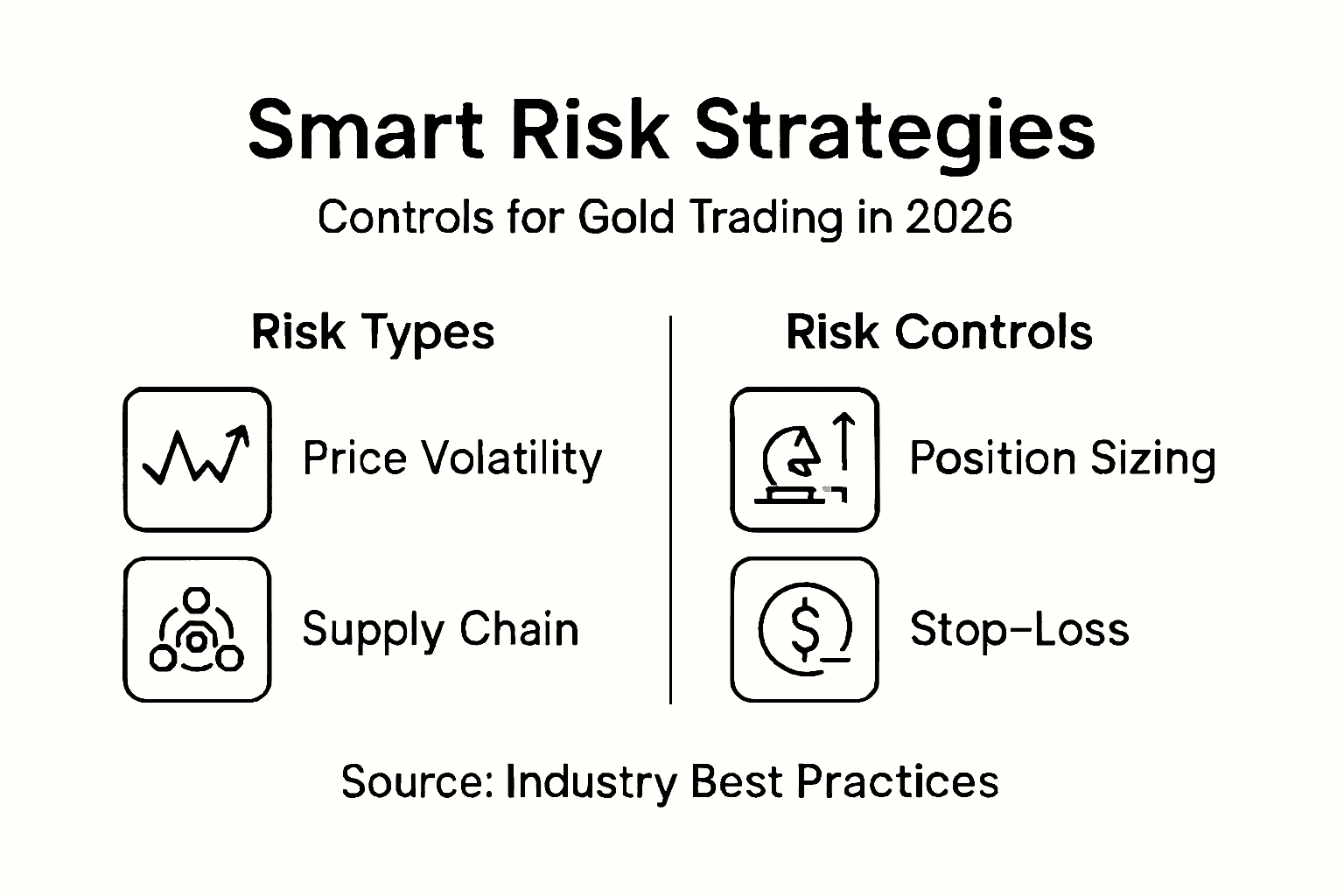
Most traders fail here by using fixed position sizes regardless of market conditions. A 2% position in 10% volatility becomes dangerously overleveraged in 30% volatility without adjustment. Your risk algorithm must automatically recalibrate position size based on real-time volatility metrics.
Implement these allocation rules:
Limit single-position exposure to 2-3% of total capital
Reduce size during earnings announcements or geopolitical uncertainty
Maintain cash reserves for opportunistic entries when dislocations occur
Scale into positions gradually rather than dumping capital all at once
Stop-Loss Orders and Protective Mechanics
Engineered stop-loss orders protect against catastrophic losses while allowing normal market noise. Your stops should sit below support levels, not inches from entry prices where false breakouts trigger exits.
The key distinction: stops prevent disasters. Take-profit levels capture gains systematically. A proper risk-reward ratio enforces that you risk $1 to make $2 or $3—never the reverse.
Disciplined Trading During High-Volume Windows
Market liquidity varies dramatically by session. Trading during peak volume windows—London opening, New York opening, Asian session overlaps—provides tighter spreads and faster execution. Off-peak trading in thin markets exposes you to massive slippage.
Your trading calendar should reflect when institutional volume appears. Avoid entering substantial positions during illiquid hours unless you have specific tactical reasons.
Risk-Reward Ratios and Fundamental Analysis
Understanding risk-reward ratios and diversifying portfolios separates professional traders from amateurs. A 1:3 risk-reward setup means risking $100,000 to potentially make $300,000—mathematically sustainable over time.
Combine technical analysis with fundamental drivers. Geopolitical tensions, real interest rates, and currency movements all influence gold pricing. Your trading plan should reference these drivers explicitly.
Discipline executed consistently beats genius executed inconsistently. Your control system must work whether markets cooperate or not.
Psychological and Operational Controls
Traders with identical risk parameters produce different results based on psychology. Pre-trade checklists, position review meetings, and trade journals create accountability. Document every trade entry reason, exit logic, and post-trade assessment.
Operationally, segregate decision-making from execution. Your trading desk shouldn’t execute trades without compliance review. Your risk team shouldn’t operate trading systems. These separations prevent casual rule violations.
Pro tip: Run quarterly stress tests simulating 2008-style market shocks; traders who’ve mentally rehearsed black swan events react with discipline rather than panic when they occur.
This table summarizes effective risk controls and their impact in gold trading:
Control Approach | Purpose | Operational Benefit |
Dynamic Position Sizing | Adjusts risk to market conditions | Capital preserved during volatility |
Automated Stop Losses | Limits single-trade losses | Prevents catastrophic drawdowns |
Scheduled Audits | Identifies system and supply risks | Early detection of vulnerabilities |
Real-Time Monitoring | Immediate detection, fast response | Minimizes exposure to market shocks |
Duty Segregation | Prevents rule violations | Reduces fraud and error potential |
Critical Mistakes and Lessons From Market Failures
History teaches harsh lessons. Institutions that ignored risk management didn’t just lose money—they collapsed, took investor capital with them, and faced criminal prosecution. Your firm can learn from their failures without repeating them.
The Barings Bank and LTCM Collapses
Historical trading failures like Barings Bank and LTCM highlight inadequate risk management and excessive leverage. Nick Leeson, a single trader, destroyed a 232-year-old institution by hiding losses in obscure accounts while leverage spiraled beyond recognition.
LTCM followed a similar path in 1998. Nobel Prize-winning economists couldn’t save the fund because poor oversight and lack of transparency created blind spots. Management didn’t know their true leverage until losses exceeded $4 billion.
The common thread: risk controls existed on paper but weren’t enforced operationally. Segregation of duties failed. Position limits weren’t monitored. Reports were manipulated or ignored.
Gold Trading Specific Mistakes
Gold traders make predictable errors that destroy returns:
Overreliance on technical indicators: Trend-following strategies fail when sentiment shifts; you’re left fighting strong momentum
Underestimating market momentum: Traders sell into bullish rallies thinking reversals are near, only to watch prices climb another 5-10%
Overconfidence after wins: Consecutive profitable trades tempt traders to abandon risk rules and increase size
Failure to protect gains: Not using trailing stops means watching $500,000 profits evaporate in days
Misreading short-term patterns: Interpreting normal pullbacks as trend reversals triggers premature exits
Emotional Decision-Making Under Pressure
Most losses stem from emotion, not analysis. A trader watching a $2 million loss accrue panics and exits precisely at the bottom. Another holds losers too long hoping for reversals.
Risk awareness and ethical trading practices require emotional discipline. Your trading plan must be documented before positions open, not invented during drawdowns.
Implement these safeguards:
Pre-trade written plans specifying entry, exit, and maximum loss
Mandatory waiting periods before reversing positions
Loss limits that trigger automatic position reduction
Weekly trade reviews analyzing why entries succeeded or failed
Senior trader approval for positions exceeding size thresholds
The institutions that survived crises had one thing in common: they enforced rules even when rules cost them money in the short term.
Excessive Leverage and Concentration Risk
Leverage amplifies both gains and losses. A 10-to-1 leverage ratio feels professional until volatility spikes and your $100 million position suddenly requires $200 million in new capital.
Concentration mirrors leverage’s dangers. Barings’ Singapore office represented 80% of the bank’s profits. One trader blowing up destroyed everything. Diversification across products, markets, and geographies sounds boring—until concentration risk obliterates your firm.
Pro tip: Create an internal “failure playbook” documenting how your firm would execute the 10% loss protocol, the 20% loss protocol, and the full position liquidation protocol—rehearse it quarterly so execution is routine, not reactive.
Strengthen Your Gold Trading Risk Management with Galami Gold
The challenge of managing price volatility, counterparty risks, and operational vulnerabilities in gold trading requires a partner that prioritizes disciplined execution and transparency at every step. As highlighted in the article, developing and enforcing robust risk controls such as position sizing, stop-loss orders, and compliance checks is critical to preserving capital and navigating the uncertain gold market in 2026.

Discover how Galami Gold offers a physical gold trading platform designed specifically for investors and institutions seeking trust, integrity, and comprehensive risk management across established gold supply chains. Visit our landing page to learn more about our gold investment and capital management services. Take control of your gold trading strategy now with proven systems that align with the smart risk management principles outlined in this guide.
Frequently Asked Questions
What is the importance of risk management in gold trading?
Risk management in gold trading is crucial as it helps identify, measure, and mitigate potential losses that can jeopardize capital and returns. It transforms trading from a gamble into a disciplined strategy with measurable guardrails.
What are the main types of risks involved in physical gold trading?
The main types of risks in physical gold trading include price volatility risk, supply chain and operational risks, compliance and financial crime risks, and regulatory/environmental risks. Each poses unique challenges that traders must navigate to ensure a secure investment.
How can I effectively manage my position sizes in gold trading?
To manage position sizes effectively, adjust them based on market volatility. Limit exposure to 2-3% of total capital per position and reduce size during periods of high volatility to prevent overleveraging and potential significant losses.
What are some common mistakes to avoid in gold trading?
Common mistakes in gold trading include overreliance on technical indicators, misreading market momentum, excessive leverage, and emotional decision-making under pressure. Traders should document their strategies and adhere to risk management principles to avoid these pitfalls.
Recommended


Comments