


Gold Investment Strategy Guide for Safer Portfolio Growth
- Shannon B
- Feb 26
- 9 min read


Market volatility regularly tests the resolve of even the most experienced institutional investors. Understanding how gold fits within a modern portfolio is central to building long-term stability and resilience. By focusing on risk tolerance and clearly defined portfolio objectives, professionals can strategically use gold to support diversification while adapting to shifting economic conditions across global markets.
Table of Contents
Quick Summary
Key Point | Explanation |
1. Define Portfolio Objectives Clearly | Identify what you aim to achieve with gold, such as wealth preservation or income generation, to guide your investment choices. |
2. Assess Your Risk Tolerance Honestly | Evaluate both your emotional comfort and actual ability to bear losses, ensuring your strategy aligns with your risk profile. |
3. Choose Gold Investment Vehicles Wisely | Select between options like physical gold, ETFs, or mining stocks based on liquidity needs, costs, and operational preferences. |
4. Implement a Disciplined Allocation Strategy | Set a target allocation percentage for gold and establish a clear buying plan to avoid emotional decisions during market fluctuations. |
5. Monitor Performance Regularly | Continuously track your gold investments against performance metrics, adjusting your strategy only when significant changes occur in market conditions. |
Step 1: Assess portfolio objectives and risk tolerance
Before allocating any capital to gold, you need a clear picture of what you’re trying to achieve and how much volatility you can actually handle. This foundational step shapes every decision that follows.
Start by defining your portfolio objectives. Are you seeking long-term wealth preservation, regular income generation, or aggressive capital appreciation? Gold serves different purposes depending on your answer. Gold’s role as a strategic long-term asset extends beyond simple price appreciation—it acts as a stabilizing force during market downturns and economic uncertainty.
Next, map out your specific financial goals:
Long-term returns targets and timeframes
Diversification requirements across asset classes
Liquidity needs for accessing capital
Income requirements versus growth preferences
Legacy or estate planning considerations
Now evaluate your risk tolerance honestly. This involves two dimensions. First, your willingness to tolerate losses—your psychological comfort with portfolio fluctuations. Second, your actual ability to bear losses given your time horizon, income stability, and reliance on invested funds. These aren’t always the same thing. Someone with high income but low risk appetite needs a different strategy than someone with substantial assets but high risk tolerance.
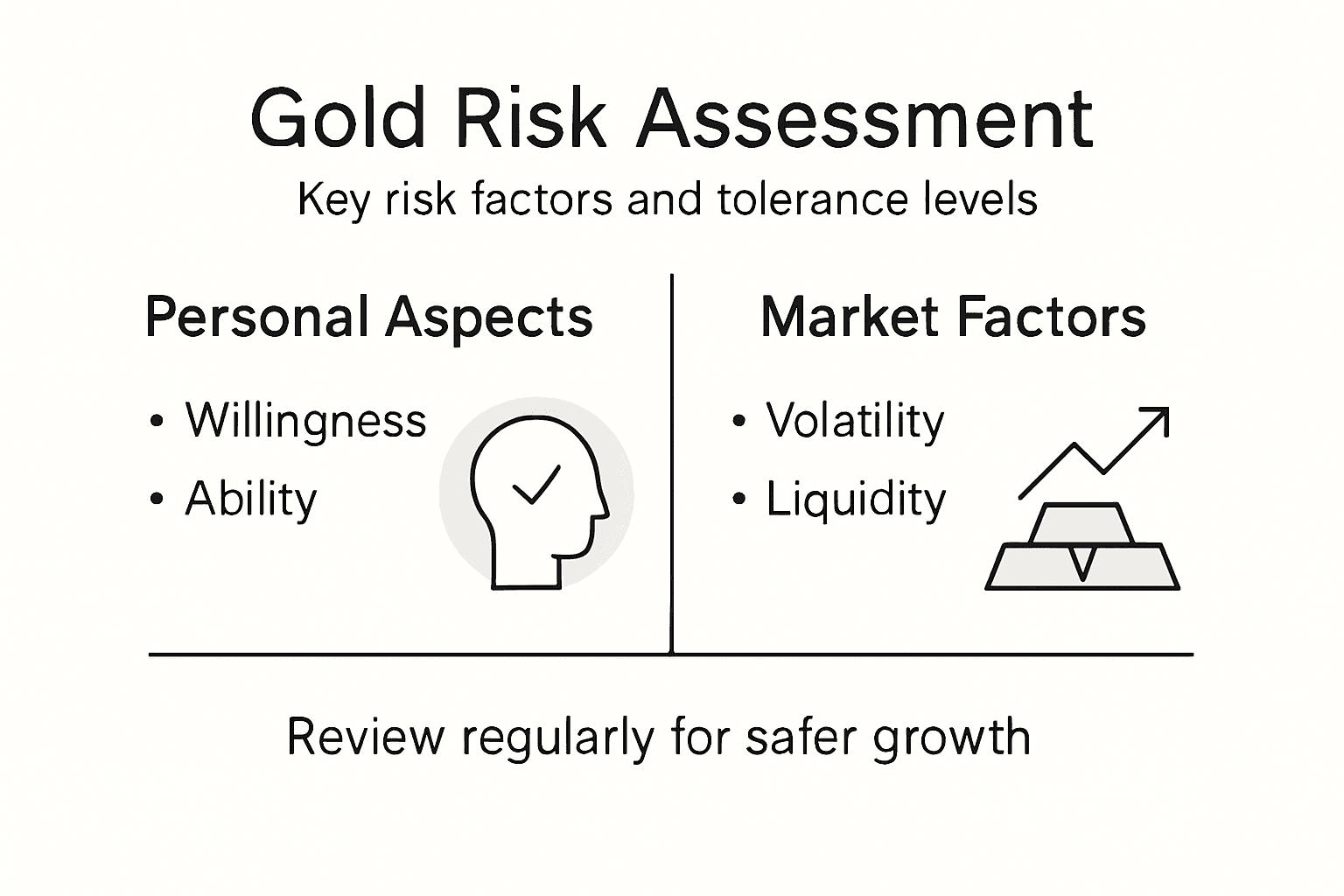
Understanding your risk tolerance requires examining multiple factors beyond just your age or income level. Consider how you’d react to a 20% portfolio decline, how long until you need these funds, and whether unexpected expenses might force you to liquidate positions.
Create a simple assessment of your situation:
List your investment time horizon (in years)
Identify your required annual withdrawals from investments
Note any major expenses or goals in the next 5-10 years
Assess your comfort level with volatility on a 1-10 scale
Evaluate how your income stability affects your investment flexibility
Your gold allocation should align with both your return objectives and your genuine ability to weather market swings without abandoning your strategy.
Pro tip: Document your risk tolerance assessment in writing now, before market emotions cloud your judgment. During market stress, you’ll reference this baseline to confirm your gold allocation still matches your true comfort level, preventing reactive decisions that derail your strategy.
Step 2: Select optimal gold investment vehicles
Now that you understand your objectives and risk tolerance, you need to choose the right investment vehicles to access gold. Different approaches suit different institutional needs and investment styles.
You have several primary options to consider:
Physical gold bullion and bars for direct ownership and storage control
Gold exchange-traded funds (ETFs) for liquid, lower-cost exposure without custody concerns
Gold mining company stocks and equity funds for leveraged upside potential
Gold futures and options contracts for sophisticated hedging or tactical positions
Gold coins and numismatic collectibles for heritage value alongside precious metals exposure
Each vehicle carries distinct trade-offs. Physical gold demands secure storage and insurance costs but gives you direct ownership and no counterparty risk. ETFs offer transparency, tax efficiency, and daily liquidity while eliminating storage responsibilities. Mining stocks provide operational leverage to gold prices but introduce company-specific risks.
Your choice depends on several factors. Consider your operational preferences, such as whether you want direct control or can delegate to fund managers. Evaluate cost structures across storage, management fees, and transaction expenses. Assess liquidity requirements and how quickly you might need to adjust positions.
To highlight how different gold investment vehicles meet institutional requirements, here is a comparison:
Vehicle Type | Liquidity Level | Storage/Custody Needs | Main Risk Exposure |
Physical Gold | Low | Secure storage, insurance | Theft, price fluctuations |
Gold ETFs | High | No physical custody | Market, tracking error |
Mining Stocks/Funds | Medium | Managed by brokerage | Company/industry specific |
Gold Futures/Options | Very High | Margin account, no storage | Leverage, contract expiry |
Coins/Collectibles | Very Low | Safe display/storage | Market, rarity, authenticity |
When optimizing your investment strategy, match your vehicle selection to your time horizon and tactical flexibility. A 20-year wealth preservation strategy might favor physical gold or core ETF positions, while active tactical positioning might use futures or mining equities.
Create a comparison of your top options:
List each vehicle you’re considering
Note the annual cost structure for each
Evaluate liquidity and transaction speed
Assess custody and operational requirements
Confirm alignment with your risk profile from Step 1
The optimal vehicle isn’t the cheapest or most popular—it’s the one that matches your exact operational capacity, time horizon, and institutional requirements.
Pro tip: Most institutional portfolios benefit from combining two vehicles rather than choosing one: perhaps core physical gold holdings for stability with a smaller ETF position for tactical rebalancing flexibility and liquidity when opportunities emerge.
Step 3: Implement disciplined gold allocation and execution
Having selected your vehicles, now comes the critical work of actually implementing your gold allocation with discipline and precision. This step separates successful institutional investors from those who drift off strategy.

Start by determining your target allocation percentage. This should reflect your portfolio size, risk profile, and objectives from Step 1. Most institutional portfolios allocate between 2% and 10% to gold, though this varies based on your specific diversification needs and market conditions.
Next, establish a clear buying plan:
Define the total dollar amount you’ll deploy to gold
Break this into purchase tranches over a reasonable timeframe
Set price targets or calendar-based schedules for each purchase
Identify your preferred execution channels for each vehicle type
Document decision criteria for timing and size adjustments
Once you’ve allocated capital, disciplined portfolio management requires periodic rebalancing to maintain your target allocation. Markets will push your gold position above or below target as prices move and other assets appreciate or depreciate.
Execute rebalancing on a defined schedule—quarterly or semi-annually works well for most institutional portfolios. Don’t chase short-term price movements or react emotionally to volatility. Your rebalancing framework should be mechanical and predetermined before emotions cloud judgment.
Use gold portfolio simulation tools to test your allocation strategy against historical scenarios. These visualizations show how your proposed gold weighting would have performed through past market cycles, inflation periods, and economic stress events.
Create your execution roadmap:
Calculate your target gold allocation in dollars
Design your purchase schedule over 3-6 months
Set rebalancing triggers and calendar dates
Document decision rules for adding or reducing gold
Track actual execution against your plan
Discipline means executing your plan even when gold seems overpriced or undervalued relative to what headlines suggest. Your allocation targets and rebalancing framework exist precisely to prevent emotional decisions.
Pro tip: Set your rebalancing triggers automatically through your portfolio management systems rather than relying on manual monitoring. When your gold position drifts beyond 15% from target, an automated alert eliminates the temptation to procrastinate or second-guess your strategy.
Step 4: Monitor performance and adjust strategies
Implementing your gold strategy is only half the battle. Ongoing monitoring and strategic adjustments ensure your portfolio stays aligned with your objectives as markets evolve and conditions change.
Start by establishing clear performance metrics that matter to your institution. Track your gold holdings separately from your broader portfolio to understand their specific contribution. Monitor both absolute returns and how gold moves relative to other assets during different market environments.
Measure what actually matters:
Here’s a summary of performance metrics for gold holdings:
Metric | Purpose | Indicative Benefit |
Absolute Return | Measures gold’s profit or loss | Tracks growth vs. targets |
Correlation with Equities | Evaluates diversification value | Lowers portfolio risk |
Volatility Reduction | Assesses impact on overall risk | Smoother portfolio returns |
Downside Protection | Performance during market stress | Shields against major drawdowns |
Total return on gold investments versus your target allocation
Gold’s correlation with stocks and bonds in your portfolio
Volatility reduction provided by your gold position
Downside protection during market stress periods
Contribution to overall portfolio risk-adjusted returns
Portfolio performance evaluation techniques like attribution analysis and benchmarking help you understand whether gold is delivering the diversification benefits you expected. Compare your gold allocation results against relevant benchmarks and historical performance patterns.
Stay informed about market conditions through continuous research. Understanding gold demand trends, macroeconomic factors, and geopolitical developments helps you anticipate when strategy adjustments become necessary. Gold market research and insights from authoritative sources keep you informed about factors influencing performance.
Adjust your strategy when conditions warrant it, not based on short-term noise. Review quarterly whether your gold allocation still matches your risk tolerance and objectives. Ask yourself these critical questions:
Has your portfolio risk profile changed since implementation?
Are market conditions fundamentally different from your assumptions?
Is gold still providing the diversification benefit you anticipated?
Have your liquidity or time horizon requirements shifted?
Should you rebalance toward or away from gold?
Monitoring isn’t about constant tweaking. It’s about identifying material changes that warrant strategic response while ignoring temporary market volatility that doesn’t alter your long-term thesis.
Pro tip: Create a standardized quarterly review process with specific metrics, documented assumptions, and decision thresholds before market movements pressure you toward reactive changes. A written policy prevents emotional decision-making during volatile periods.
Strengthen Your Portfolio with Disciplined Gold Investment Execution
Navigating the complexities of gold investment strategy requires more than understanding risk tolerance and allocation. The key challenge is executing your gold allocation with discipline and leveraging the right investment vehicles to ensure consistent, safer portfolio growth. Whether you are contemplating physical gold ownership or liquid ETFs, matching your operational capacity with a transparent, trusted trading platform is essential to avoid costly missteps.
At Galami Gold, we specialize in delivering disciplined execution and risk management solutions backed by well-established gold supply chains. Our platform provides institutional investors and sophisticated portfolio managers with confidence and operational transparency, reinforcing your strategic gold allocation goals. Discover how our efficient capital deployment and trustworthy trading approach can help you maintain your ideal gold exposure aligned with your portfolio objectives and risk profile.

Take the next step toward optimizing your gold strategy by exploring our gold trading program. Experience firsthand the benefits of partnering with a platform that prioritizes integrity and disciplined execution. Secure your portfolio’s growth path today with Galami Gold and transform your understanding of gold investing into measurable results.
Frequently Asked Questions
What are the key objectives to consider when investing in gold?
Investing in gold requires clarity on your portfolio objectives, such as whether you’re aiming for long-term wealth preservation, regular income, or capital appreciation. Define your specific financial goals, including return targets and liquidity needs, to align your gold investment strategy with your overall portfolio.
How do I assess my risk tolerance before investing in gold?
Evaluate your risk tolerance by considering both your willingness and ability to handle losses. Create a simple assessment that includes your investment time horizon, required annual withdrawals, and comfort level with market volatility to ensure your gold allocation fits your risk profile.
What are the different vehicles for investing in gold?
You can invest in gold through various vehicles, including physical gold, gold exchange-traded funds (ETFs), gold mining stocks, futures, and numismatic coins. Analyze the liquidity, cost structures, and storage needs of each option to select the vehicle that matches your investment strategy and profile.
How should I implement my gold allocation once I’ve determined it?
Establish a target allocation percentage for gold and create a structured buying plan that includes the amount to invest and a timeline for purchases. Document your criteria for rebalancing to keep your gold investment aligned with your overall portfolio objectives over time.
What performance metrics should I use to monitor my gold investments?
Monitor key metrics like absolute returns, correlation with other assets, volatility reduction, and downside protection to evaluate your gold portfolio’s performance. Regularly re-evaluate these metrics to ensure your gold investments continue to meet your financial goals and adjust your strategy if necessary.
How often should I review and adjust my gold investment strategy?
Perform a quarterly review of your gold allocation and performance metrics to ensure they align with your investment objectives. Ask yourself critical questions about changes in your risk profile or market conditions, and adjust your strategy only when significant shifts occur.
Recommended


Comments