


Gold trading standards for institutional investors 2026
- Shannon B
- Mar 17
- 9 min read


Many institutional investors still believe gold trading is straightforward, a simple buy and hold strategy immune to operational complexity. This assumption can be costly. In reality, institutional gold trading demands rigorous adherence to precise industry standards governing physical specifications, market infrastructure, ethical conduct, and risk controls. Understanding these standards is not optional for wealth managers and institutional investors seeking to deploy capital efficiently while managing counterparty, settlement, and reputational risks. This guide explains the essential gold trading standards institutions must master in 2026 to optimize their strategies and safeguard portfolios.
Table of Contents
Key takeaways
Point | Details |
LBMA Loco London dominates | The LBMA Loco London market processes over $25 billion daily, setting the global standard for OTC institutional gold trades and physical settlement. |
Good Delivery bars ensure liquidity | Bars must weigh 350 to 430 fine troy ounces with minimum 995 fineness and come from accredited refiners to guarantee acceptance in settlements. |
Global Precious Metals Code governs ethics | The GPMC mandates governance, risk management, and ethical conduct for LBMA members, recognized by the FCA for regulated market behavior. |
Risk management protects capital | Institutional strategies employ position sizing at 0.5 to 2 percent of capital, ATR-based stops, and VaR models to manage gold volatility and tail risk. |
Responsible sourcing mitigates reputational risk | OECD-based due diligence and annual audits ensure suppliers meet human rights standards, protecting institutions from legal and compliance exposures. |
The LBMA Loco London market: core standard for institutional gold trading
The LBMA Loco London market operates OTC 24/7 with $25B daily settlement and uses Good Delivery bars for physical settlement. This market represents the heart of institutional gold trading, where the majority of large scale transactions occur between banks, hedge funds, and wealth management firms. Unlike exchange traded products, Loco London trades are bilateral, meaning counterparties negotiate directly without a centralized order book. This structure provides flexibility in pricing and execution but requires robust credit risk assessment and clearing arrangements.
Clearing is handled by six LBMA clearing members who net trades and facilitate physical delivery when required. Daily trading volumes regularly exceed 20 million troy ounces, demonstrating the market’s depth and liquidity. Physical settlement occurs through the transfer of Good Delivery bars held in London vaults, ensuring that trades can be backed by tangible metal rather than purely paper claims. This physical backbone distinguishes Loco London from purely speculative markets and underpins its status as the global pricing benchmark.
Institutional investors rely on this market standard because it combines liquidity, transparency, and the ability to take or make physical delivery. The continuous trading environment allows institutions to adjust positions in response to macroeconomic shifts, central bank policy changes, or currency fluctuations at any hour. For wealth managers constructing diversified portfolios, understanding Loco London mechanics is fundamental. It informs decisions on counterparty selection, settlement timelines, and the operational infrastructure required to participate effectively.
Key features of the LBMA Loco London market include:
Bilateral OTC trades negotiated directly between counterparties
Six clearing members providing netting and settlement services
Physical delivery via Good Delivery bars held in accredited London vaults
Daily volumes exceeding 20 million troy ounces and $25 billion in value
Continuous 24/7 trading accommodating global time zones
For institutions evaluating gold trading platforms institutional investors 2026, aligning with Loco London standards ensures compatibility with the deepest liquidity pool and the most recognized settlement infrastructure in the industry.
Good Delivery standards: specifications for physical gold
Good Delivery bars weigh 350 to 430 fine troy oz with min 995 fineness and strict marking and accreditations. These specifications are not arbitrary. They ensure uniformity, facilitate efficient settlement, and reduce the risk of disputes over bar quality or authenticity. Each bar must carry a serial number, the refiner’s hallmark, the year of manufacture, and fineness stamps. This traceability is critical for institutional investors who need to verify provenance and comply with anti-money laundering and responsible sourcing regulations.

Accreditation of refiners is equally rigorous. Only bars from refiners producing 10t+ annually and meeting net worth criteria are accepted. Refiners must demonstrate financial stability, technical capability, and adherence to quality assurance protocols. The LBMA maintains a Good Delivery List of approved refiners, which is updated regularly to reflect audits and compliance reviews. Bars from unlisted refiners are not accepted for settlement in the Loco London market, effectively rendering them illiquid for institutional purposes.
The importance of these standards extends beyond settlement mechanics. Good Delivery bars command a premium in secondary markets because buyers trust their quality and accept them without additional assays. This liquidity premium translates into tighter bid ask spreads and lower transaction costs for institutions. Conversely, non-standard bars may require re-refining or deep discounts to find buyers, eroding returns and complicating exit strategies.
Specification | Requirement |
Weight range | 350 to 430 fine troy ounces |
Minimum fineness | 995 parts per thousand (99.5% pure gold) |
Markings required | Serial number, refiner hallmark, year, fineness |
Refiner accreditation | Minimum 10 tonnes annual production, financial stability, quality assurance |
Settlement acceptance | LBMA Good Delivery List refiners only |
Pro Tip: Always verify that bars in your custody or proposed for acquisition appear on the current LBMA Good Delivery List. Counterfeit bars and those from delisted refiners can surface in secondary markets, and accepting them exposes your institution to settlement failures and reputational damage.
For wealth managers concerned about institutional gold investing key risks, ensuring compliance with Good Delivery standards is a foundational control that mitigates operational and liquidity risks.
Global Precious Metals Code and ethical risk governance
The GPMC sets principles covering ethics, governance, and risk management, mandatory for LBMA members and FCA-recognized for regulated conduct. The Code was developed to address gaps in market conduct and restore confidence following scandals involving benchmark manipulation and unethical trading practices. It establishes a framework for how market participants should behave, emphasizing transparency, fairness, and accountability.
Adherence to the GPMC is mandatory for LBMA members, but it also serves as a voluntary best practice benchmark for other institutions globally. The Financial Conduct Authority in the UK recognizes the GPMC as a standard for regulated firms, meaning that non-compliance can trigger regulatory scrutiny and enforcement actions. For institutional investors, this recognition elevates the GPMC from a voluntary guideline to a de facto compliance requirement when operating in major markets.
Core principles of the GPMC include:
Ethics: Conduct business with integrity, avoid conflicts of interest, and ensure fair treatment of counterparties
Governance: Establish clear accountability, robust internal controls, and effective oversight of trading activities
Risk management: Identify, assess, and mitigate risks including market, credit, operational, and reputational exposures
Information sharing: Communicate transparently with clients and counterparties, providing accurate and timely information
Compliance: Adhere to applicable laws, regulations, and industry standards, with regular reviews and updates
The GPMC is not static. Version 3 is scheduled for release in 2026, incorporating lessons learned from recent market disruptions and evolving regulatory expectations. Institutions should monitor these updates and adjust their policies accordingly to maintain alignment with best practices.
For wealth managers, integrating GPMC principles into trading operations reduces reputational risk and enhances client confidence. Demonstrating adherence signals to investors that the institution prioritizes ethical conduct and robust governance, differentiating it from competitors who may take shortcuts. Partnering with firms that also embrace the GPMC, such as partner gold traders risk management transparency, further strengthens this commitment.
Risk management and responsible sourcing in institutional gold trading
Institutional risk management employs position sizing at 0.5 to 2%, ATR-based stops, and VaR/ES models; Basel III impacts metals financing liquidity. Position sizing is the first line of defense against outsized losses. Allocating no more than 0.5 to 2 percent of total capital to a single gold trade limits downside exposure while allowing meaningful participation in market moves. This range reflects the balance between capturing opportunity and preserving capital, adjusted for the institution’s risk appetite and portfolio volatility.
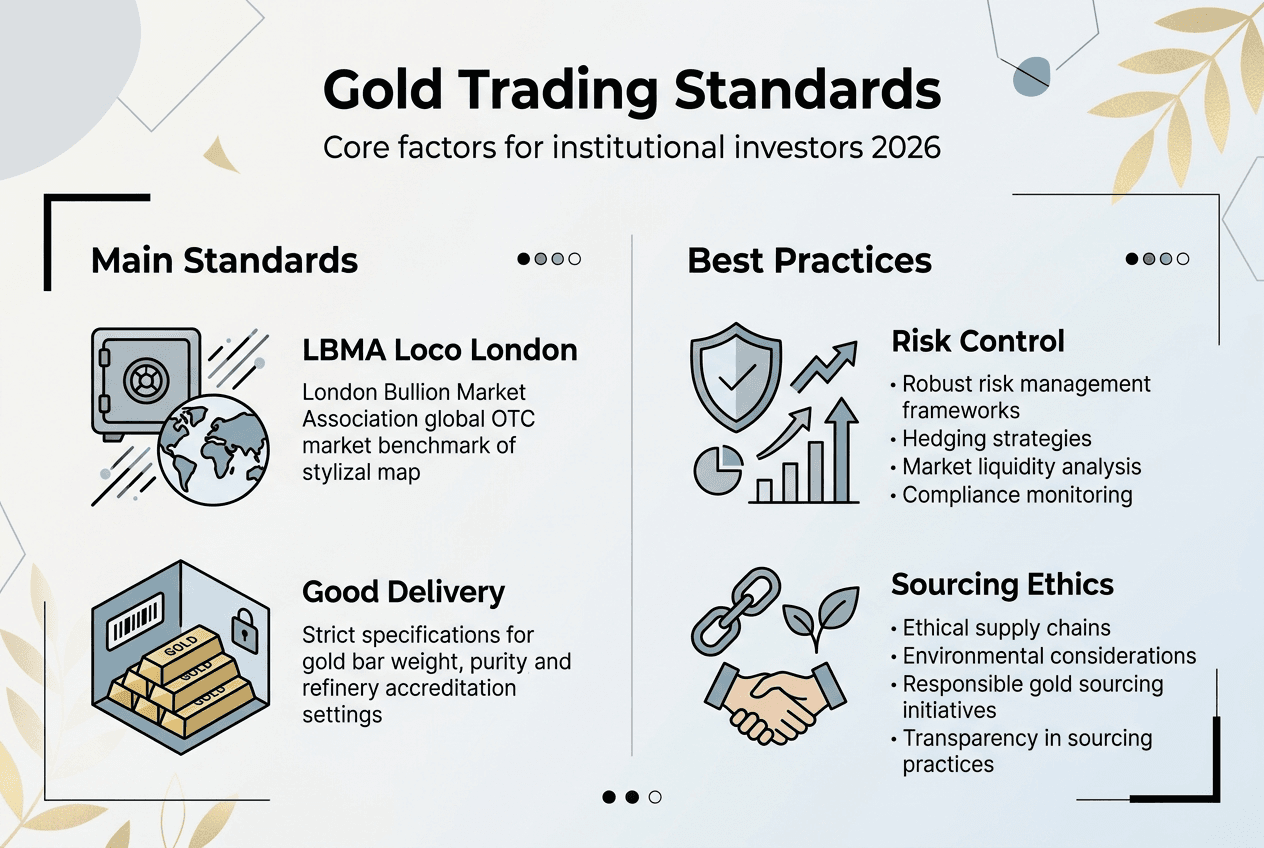
Stop loss orders based on Average True Range provide dynamic risk controls that adapt to changing market conditions. ATR measures recent volatility, allowing institutions to set stops that avoid premature exits during normal fluctuations while protecting against sustained adverse moves. Combining ATR stops with VaR and Expected Shortfall models gives a comprehensive view of tail risk, enabling proactive adjustments before losses escalate.
Basel III regulations have introduced additional complexity by increasing the capital charges banks must hold against unallocated gold positions. This has reduced the availability of financing for physical gold trades, tightening liquidity in some segments and raising borrowing costs. Institutions must factor these financing constraints into their trading strategies, potentially favoring allocated storage or direct ownership to avoid reliance on bank credit lines.
Responsible sourcing is equally critical. Responsible sourcing follows a five-step OECD-based due diligence with audits and zero tolerance to human rights abuses per LBMA guidance. These steps include establishing strong company management systems, identifying and assessing risks in the supply chain, designing and implementing strategies to respond to identified risks, conducting independent third-party audits, and publicly reporting on due diligence practices.
Annual audits of refiners and suppliers ensure ongoing compliance and detect any lapses in standards. Institutions that fail to conduct adequate due diligence face legal liability, regulatory penalties, and reputational damage if their gold is later linked to conflict zones, child labor, or environmental destruction. The LBMA Responsible Gold Guidance Version 9 provides detailed protocols for conducting these audits and responding to red flags.
Practical risk and due diligence steps for institutional investors:
Establish position sizing limits at 0.5 to 2 percent of capital per trade to control downside exposure.
Implement ATR-based stop losses adjusted for recent volatility to avoid premature exits and limit losses.
Use VaR and Expected Shortfall models to assess tail risk and adjust portfolio exposure dynamically.
Conduct annual audits of refiners and suppliers following OECD and LBMA responsible sourcing protocols.
Monitor Basel III impacts on financing costs and liquidity, adjusting strategies to favor allocated storage if necessary.
Pro Tip: Integrate risk management and responsible sourcing policies into a unified compliance framework. This ensures that trading decisions consider both financial and ethical dimensions, reducing the likelihood of costly oversights and enhancing institutional resilience.
For institutions seeking to manage risk gold investment and understand examples gold investment risks institutions 2026, these frameworks provide actionable guidance for navigating the complexities of modern gold markets.
Partner with Galami Gold for compliant institutional trading
Navigating the intricate landscape of gold trading standards requires more than theoretical knowledge. It demands a partner with proven expertise, transparent operations, and unwavering commitment to compliance. Galami Gold operates as a physical gold trading platform dedicated to disciplined execution, transparency, and managing risk across well-established supply chains. Our adherence to LBMA and GPMC standards ensures that your trades are backed by Good Delivery bars, cleared through accredited channels, and sourced responsibly.

Our audited processes provide institutional investors with confidence that every transaction meets the highest industry benchmarks. We integrate robust risk management frameworks, including position sizing, stop loss protocols, and VaR modeling, to protect your capital while pursuing growth. By partnering with Galami Gold, you gain access to a network of accredited refiners, transparent pricing, and operational infrastructure designed for institutional scale. Whether you are deploying capital for portfolio diversification, hedging currency risk, or seeking long-term wealth preservation, our team delivers tailored strategies aligned with your objectives.
Pro Tip: Leverage expert partners who prioritize compliance and transparency to enhance your institutional gold trading performance. This approach not only mitigates operational and reputational risks but also frees your team to focus on strategic asset allocation rather than navigating complex settlement and sourcing challenges.
Explore how you can invest in physical gold trading audited with a partner committed to integrity and excellence. Connect with us today to discuss your institution’s unique needs and discover how our risk management gold trading capabilities can strengthen your portfolio.
FAQ
What defines a Good Delivery gold bar?
A Good Delivery bar weighs between 350 and 430 fine troy ounces with a minimum fineness of 995 parts per thousand. It must carry a serial number, refiner hallmark, year of manufacture, and fineness stamps. Only bars produced by LBMA-accredited refiners who meet strict quality, production, and financial criteria are accepted for settlement in the Loco London market.
How does the Global Precious Metals Code impact institutional trading?
The GPMC mandates governance, risk management, and ethical conduct for all LBMA members and is recognized by the FCA for regulated firms. It establishes principles covering integrity, transparency, and accountability, reducing the risk of market manipulation and unethical behavior. Institutions adhering to the GPMC demonstrate commitment to best practices, enhancing reputational standing and client confidence.
What risk management practices are essential for trading gold?
Institutional investors should use position sizing between 0.5 and 2 percent of capital per trade to limit downside exposure. Implement ATR-based stop losses that adjust for recent volatility to avoid premature exits while protecting against sustained losses. Apply VaR and Expected Shortfall models to assess tail risk and adjust portfolio exposure proactively based on changing market conditions.
Why is responsible sourcing critical in gold trading?
Responsible sourcing ensures that gold suppliers meet OECD-based due diligence steps, eliminating human rights abuses, conflict financing, and environmental harm. Institutions that fail to conduct adequate due diligence face legal liability, regulatory penalties, and severe reputational damage. Annual audits and zero tolerance policies protect investors from these risks and align operations with evolving ESG expectations.
Recommended


Comments