


What is institutional gold trading: a complete guide
- Shannon B
- Mar 22
- 8 min read


Most investors imagine gold trading as simple buy-and-sell orders on an exchange, but institutional gold trading operates in a vastly different universe. The mechanics involve decentralized over-the-counter markets, London Bullion Market Association auctions, and COMEX futures, each with distinct roles in price discovery and execution. Physical delivery logistics, credit risk, and regional premiums add layers of complexity absent from retail platforms. This guide unpacks the foundational mechanisms, strategic applications, and practical challenges that define institutional gold trading, equipping wealth managers and institutional investors with the knowledge to optimize capital allocation in precious metals markets.
Table of Contents
Key Takeaways
Point | Details |
OTC led trading | Institutional gold trading mainly occurs in the over-the-counter market, is bilateral and decentralized, handles large negotiated trades, and requires robust counterparty due diligence due to embedded credit risk. |
LBMA price benchmark | LBMA auctions provide the global spot price benchmark, operate electronically twice daily, and offer transparency on volumes and participation for sentiment insight. |
COMEX futures role | COMEX futures deliver liquidity and leverage for speculation hedging and arbitrage, enabling multi market strategies while exposing traders to basis risk and delivery logistics. |
Physical versus paper | Physical gold involves allocated vaulting and delivery timelines verified against Good Delivery standards, unlike paper gold which settles financially without moving metal. |
Regional premiums signals | Premiums and discounts vary by region reflecting logistics and demand, creating arbitrage opportunities and signaling market stress when spreads widen. |
Understanding the institutional gold trading landscape
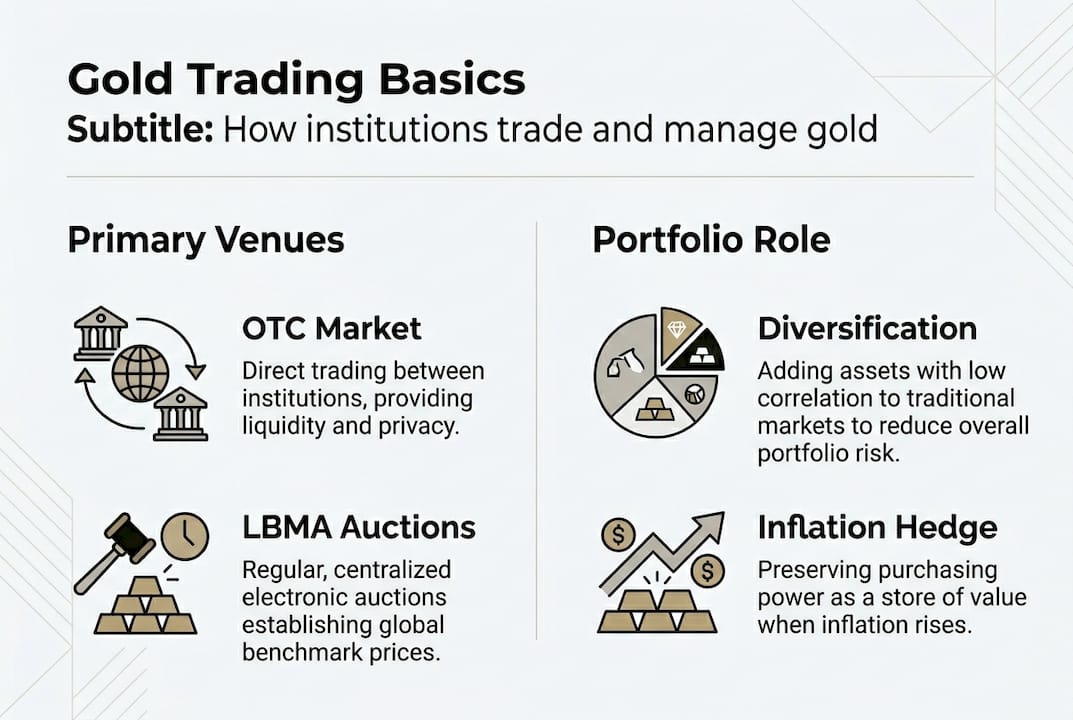
Institutional gold trading primarily occurs in the over-the-counter market, which is bilateral, decentralized, and handles large negotiated trades by banks, bullion desks, refineries, and institutional investors. Unlike exchange-traded products, OTC transactions reflect real physical demand and embed credit risk between counterparties. Settlement typically happens loco London, meaning gold is delivered or allocated in London vaults, the global standard for institutional trades. This structure allows flexibility in trade size and terms but requires robust counterparty due diligence.
The LBMA auctions serve as the benchmark for global gold spot price discovery, operating electronically with order-driven mechanics twice daily. These auctions aggregate demand and supply from major market participants, establishing reference prices used across OTC and derivative markets. Transparency in auction volumes and participation provides insight into institutional sentiment, making it a critical data point for portfolio managers. Monitoring auction dynamics helps anticipate short-term price movements and liquidity conditions.
COMEX futures complement OTC and LBMA markets by offering standardized contracts for speculation, hedging, and arbitrage. Futures provide high liquidity and leverage, enabling institutional investors to manage exposure without immediate physical settlement. Arbitrage between COMEX and OTC markets ensures price alignment, though basis risk and delivery logistics can create temporary divergences. Understanding the interplay between these venues is essential for executing multi-market strategies.
Premiums and discounts vary by region, influenced by delivery logistics, local demand, and dealer inventory constraints. For example, Shanghai premiums often exceed London prices during periods of strong Asian demand, while COMEX may trade at discounts during liquidity crunches. These spreads create arbitrage opportunities but also signal underlying market stress. Institutional participants include bullion banks, refineries, central banks, and large asset managers, each contributing to market depth and price formation.
Pro Tip: Track LBMA auction volumes and participation trends to gauge institutional sentiment. Rising volumes often precede volatility, while declining participation can signal risk aversion or liquidity constraints.
For investors seeking streamlined access to institutional gold markets, gold trading platforms 2026 offer specialized infrastructure and compliance frameworks.
Physical vs paper gold: premiums, logistics, and risks
Physical gold trading involves actual gold bars, allocated vaulting, and settlement terms that require coordination between refineries, vaults, and transport providers. Allocated gold means specific bars are assigned to the investor, eliminating counterparty risk inherent in unallocated accounts. Settlement terms dictate delivery timelines, typically T+2 for loco London trades, and involve verification of bar quality against LBMA Good Delivery standards. This process contrasts sharply with paper gold products, which settle financially without physical movement.

Paper gold, including COMEX futures and gold ETFs, represents derivative claims on gold without immediate physical backing. Futures contracts allow cash settlement, meaning investors can close positions without taking delivery. ETFs hold physical gold in trust but offer shares that trade like stocks, providing liquidity without the logistics of bar storage. These products suit tactical trading but introduce tracking error and counterparty risk absent from direct physical ownership.
Premiums and discounts reflect logistics, credit risk, and dealer inventory, with divergences widening during market stress. For instance, Shanghai premiums surged during 2025 geopolitical tensions, while COMEX experienced flash crashes due to margin calls and forced liquidations. These events highlight how physical and paper markets can decouple temporarily, creating arbitrage opportunities for well-positioned institutions. Understanding these dynamics is critical for timing entry and exit points.
Characteristic | Physical Gold | Paper Gold |
Price basis | Spot plus premium | Futures or ETF NAV |
Liquidity | Moderate, depends on vault access | High, exchange-traded |
Credit risk | Counterparty in unallocated | ETF structure or clearinghouse |
Settlement | T+2, physical delivery | T+1, cash or share transfer |
Logistics | Vaulting, transport, insurance | None, electronic |
Physical gold trading carries specific risks that require active management:
Credit risk from counterparties in unallocated accounts or OTC trades
Delivery risk due to transport delays, customs issues, or vault capacity constraints
Custody risk if vaulting arrangements lack proper insurance or audit trails
Liquidity risk during market stress when dealers widen spreads or refuse bids
Dealer inventory and risk limits widen spreads, particularly when geopolitical sanctions or regulatory changes constrain arbitrage flows. Cross-market premiums can exceed 2% during extreme conditions, making physical delivery thresholds critical for arbitrage profitability. Institutions must monitor these thresholds and adjust strategies accordingly.
Pro Tip: Prioritize allocated vaulting in London for pure execution and liquidity. Loco London remains the global standard, ensuring fungibility and minimizing settlement friction.
For deeper insights into execution mechanics, review the physical gold trading guide and institutional gold investing considerations.
Strategic role of gold in institutional portfolios
Institutional investors deploy gold across multiple strategic functions, each addressing distinct portfolio objectives:
Diversification: Gold exhibits low correlation with equities and bonds, reducing overall portfolio volatility.
Inflation hedge: Gold preserves purchasing power during periods of rising consumer prices and currency devaluation.
Crisis hedge: Gold rallies during geopolitical shocks, financial crises, and systemic risk events.
Zero-beta asset: Gold provides returns independent of equity market factors, enhancing risk-adjusted performance.
Liquidity enhancer: Gold can be liquidated quickly in OTC or futures markets, providing emergency capital.
Hybrid SVR-PPO strategies for tactical ETF trades incorporate market sentiment and volatility indices, outperforming static buy-and-hold approaches. These strategies use support vector regression and proximal policy optimization to time entries and exits based on technical indicators and macroeconomic signals. Backtesting shows improved Sharpe ratios and reduced drawdowns compared to passive gold allocations.
Monitoring central bank flows and geopolitical risks informs allocation decisions. Central banks increased gold reserves by 1,100 tons in 2025, signaling confidence in gold as a reserve asset amid de-dollarization trends. Geopolitical sanctions and trade tensions elevate gold’s safe-haven appeal, justifying tactical overweights during heightened uncertainty. Portfolio managers should integrate these macro factors into dynamic allocation models.
Gold’s consistent role in managing downside risk across major economies makes it indispensable for institutional portfolios seeking resilience against tail events and market dislocations.
Portfolio optimal gold allocations for institutions typically range around 5%, balancing diversification benefits with opportunity costs. Allocations above 10% may dilute growth potential, while allocations below 3% provide insufficient hedging during crises. Mean-variance optimization frameworks incorporating gold improve efficient frontier outcomes, particularly for risk-averse mandates.
Pro Tip: Integrate gold allocation with risk models comparing gold returns to T-bills. This analysis reveals gold’s superior risk-adjusted performance during equity bear markets, justifying strategic overweights.
Explore gold portfolio diversification and gold risk management for actionable frameworks.
Navigating institutional gold trading challenges and market nuances
Institutional gold trading presents operational and strategic challenges that require specialized expertise:
Credit risk: Counterparties may default on OTC trades, particularly during financial stress or margin calls.
Settlement delays: Physical delivery can extend beyond T+2 due to vault congestion, customs clearance, or documentation errors.
Logistics complexity: Coordinating transport, insurance, and vault allocation across jurisdictions increases operational overhead.
Inventory and risk limits: Dealers constrain position sizes and widen spreads when inventory approaches risk thresholds, reducing liquidity.
Structural demand from central banks and cyclical factors like Federal Reserve policy create distinct trading environments. Structural demand reflects long-term reserve accumulation and de-dollarization, supporting sustained price floors. Cyclical demand responds to interest rate changes, inflation expectations, and currency fluctuations, driving short-term volatility. Distinguishing these forces helps institutions time entries and avoid chasing momentum.
Demand Driver | Structural | Cyclical |
Primary source | Central bank purchases, de-dollarization | Fed policy, interest rates, inflation |
Time horizon | Multi-year | Quarterly to annual |
Price impact | Establishes floor, reduces downside | Drives volatility, short-term trends |
Trading strategy | Buy dips, long-term hold | Tactical overweights, momentum trades |
Dealer risk limits widen spreads, particularly when geopolitical sanctions lower arbitrage yields significantly. For example, sanctions on Russian gold exports in 2025 compressed arbitrage opportunities between London and Moscow, reducing dealer participation and widening bid-ask spreads. Institutions must anticipate these dynamics and adjust execution strategies to minimize slippage.
Pro Tip: Monitor dealer inventory and risk limits as indicative signals for market spreads and liquidity shifts. Rising inventory often precedes spread compression, while declining inventory signals tightening and potential price spikes.
Adherence to LBMA Good Delivery standards and understanding terminology like loco London, allocated, and unallocated ensures effective communication with counterparties and reduces execution errors. Familiarize your team with gold trading standards 2026 and gold trading terminology to streamline operations.
Explore Galami Gold’s institutional trading solutions
Galami Gold provides audited physical gold trading infrastructure tailored for institutional investors seeking transparency, compliance, and optimized execution. The platform emphasizes disciplined capital deployment across established supply chains, reducing operational friction and counterparty risk. Institutional clients benefit from:
High ROI potential through efficient execution and minimized premiums
Full transparency with audited vaulting and real-time reporting
Custody solutions meeting LBMA Good Delivery standards
Compliance frameworks aligned with institutional regulatory requirements

Pro Tip: Leverage specialized platforms like Galami Gold to access optimized trading and vaulting infrastructure, reducing the operational burden of managing physical gold logistics internally.
Visit institutional gold trading solutions to explore tailored investment options and enhance your precious metals strategy.
Frequently asked questions
What is institutional gold trading?
Institutional gold trading involves large-scale transactions in OTC markets, LBMA auctions, and COMEX futures by banks, asset managers, and central banks. It emphasizes physical delivery, allocated vaulting, and credit risk management, distinguishing it from retail trading platforms.
What are the key trading venues for institutional gold?
The primary venues include the OTC market for bilateral trades, LBMA auctions for benchmark pricing, and COMEX futures for liquidity and hedging. Each venue serves distinct functions, with OTC reflecting physical demand and COMEX enabling leverage and arbitrage.
How does physical gold differ from paper gold?
Physical gold requires actual delivery, allocated vaulting, and settlement logistics, embedding credit and custody risks. Paper gold, like futures and ETFs, settles financially without physical movement, offering higher liquidity but introducing tracking error and counterparty risk.
Why do institutional portfolios include gold?
Gold enhances diversification, hedges inflation and crises, and provides zero-beta returns independent of equity markets. Allocations around 5% improve risk-adjusted performance and reduce drawdowns during market stress.
What challenges do institutions face in gold trading?
Key challenges include credit risk from counterparties, settlement delays, logistics complexity, and dealer inventory constraints that widen spreads. Geopolitical sanctions and regulatory changes further complicate arbitrage and liquidity.
Recommended


Comments