


How to invest in gold for portfolio diversification 2026
- Shannon B
- Mar 16
- 9 min read


Institutional investors and high-net-worth individuals face unprecedented market volatility in 2026, driving a strategic shift toward alternative assets that offer true diversification benefits. Gold has emerged as a critical portfolio component, with prices surging past $4,000 and ETF holdings reaching all-time highs of 4,145 tons. This guide explains how sophisticated investors can effectively allocate capital to gold through transparent, risk-managed trading platforms that deliver both security and liquidity. We’ll cover strategic positioning, investment vehicle selection, platform evaluation, and ongoing portfolio monitoring to maximize gold’s diversification value.
Table of Contents
Key takeaways
Point | Details |
Record gold inflows | Gold ETFs hold $669 billion in assets at unprecedented levels in 2026. |
Rising allocations | Institutional investors increased gold positions from 5% to 25% of portfolio value. |
Platform selection | Transparent trading platforms with tight spreads and reliable execution are essential for institutional gold investing. |
Volatility management | Gold’s low correlation with equities provides diversification, but requires active risk monitoring during price consolidations. |
Strategic demand | Central banks added 297 tons in 2025, signaling long-term structural support for gold prices. |
Understanding gold as a strategic investment asset
Gold functions as a low-correlation asset that protects purchasing power during periods of currency devaluation and economic uncertainty. Unlike equities or bonds, gold maintains value independently of corporate earnings or government fiscal health. This fundamental characteristic makes it indispensable for portfolio construction in 2026, when traditional 60/40 models face increasing pressure from synchronized stock and bond market declines.
Structural shifts in the global monetary system amplify gold’s strategic importance. De-dollarization trends among emerging economies create persistent demand for alternative reserve assets. Central banks worldwide recognized this dynamic by adding 297 tons of gold to reserves in 2025, demonstrating institutional confidence in gold’s long-term value preservation capabilities. This official sector buying establishes a price floor that supports private investment strategies.
The evolution beyond traditional portfolio models reflects changing risk dynamics. Institutional buyers grew allocations from 5% to 25% as concerns mounted over equity valuations and bond duration risk. Gold serves as a third pillar alongside stocks and fixed income, reducing overall portfolio volatility while maintaining return potential. This reallocation represents a permanent shift rather than tactical positioning, as sophisticated investors recognize gold’s role in modern wealth preservation.
Market volatility in 2026 underscores these diversification benefits. Geopolitical tensions, inflation persistence, and monetary policy uncertainty create conditions where gold thrives. The asset’s low correlation with equities becomes most valuable precisely when stock markets experience stress. Investors who maintained gold positions during recent corrections preserved capital while equity-only portfolios suffered significant drawdowns.
Pro Tip: Review your current portfolio’s correlation matrix quarterly to identify when gold exposure should be adjusted based on changing relationships between asset classes.
Explore comprehensive strategies for gold portfolio risk management in 2026 to optimize your allocation framework.
“Gold’s role has evolved from a fringe holding to a core portfolio component as institutional investors recognize its unique ability to preserve wealth across economic cycles and monetary regimes.”
Preparing to invest in gold: options and prerequisites
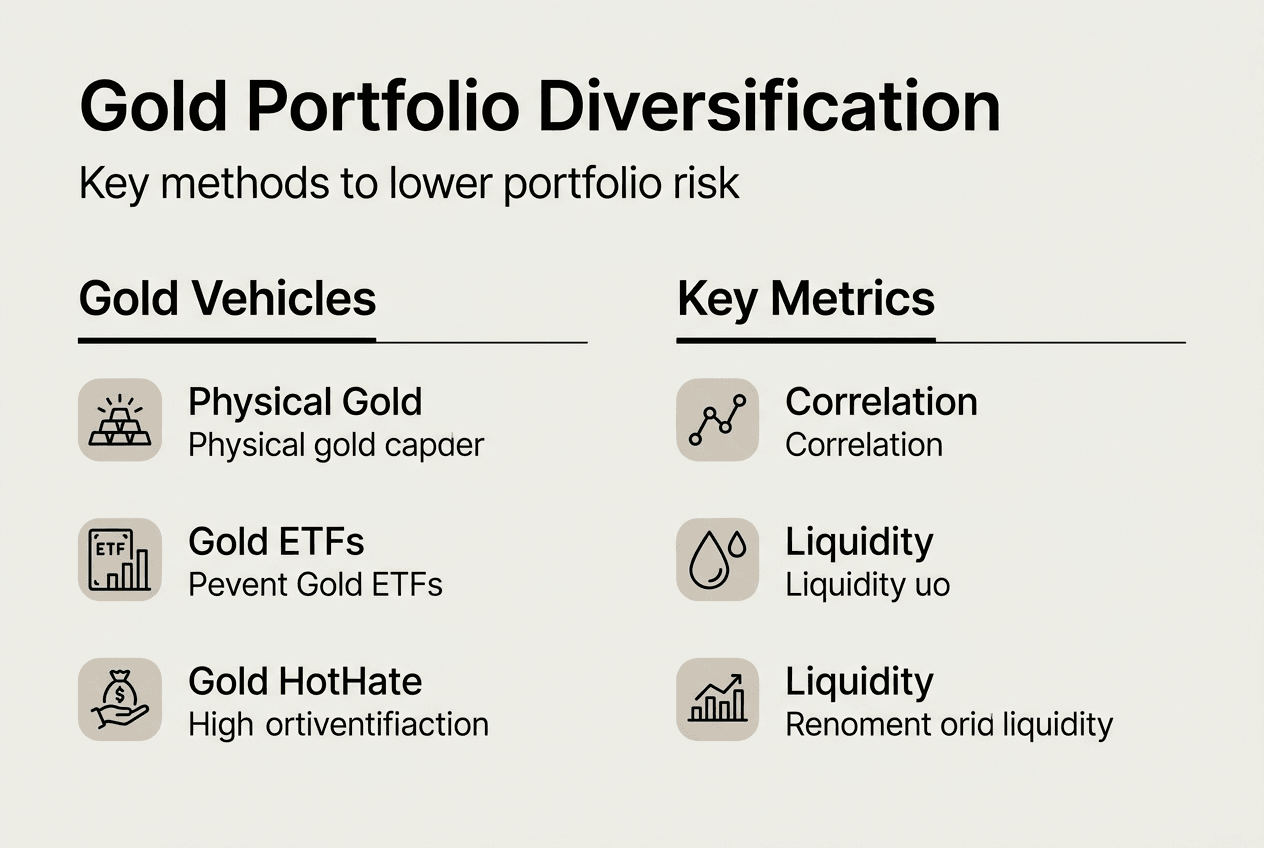
Institutional investors must evaluate three primary gold investment vehicles, each offering distinct trade-offs between physical ownership, liquidity, and operational complexity. Physical gold provides direct ownership and eliminates counterparty risk, but requires secure storage infrastructure and regular auditing protocols. Investors holding physical bars or coins maintain complete control over their assets, though storage costs and insurance premiums add ongoing expenses that reduce net returns.
Gold ETFs deliver exceptional liquidity and ease of trading through exchange-listed securities. These funds hold $669 billion in assets and track spot gold prices with minimal tracking error. However, ETF investors lack physical delivery rights, creating a layer of abstraction between ownership and underlying metal. This structure works well for tactical allocations but may not satisfy investors seeking direct precious metal exposure for wealth preservation.

Trading platforms represent a third option, combining elements of physical and paper gold investing. Sophisticated platforms offer tight bid-ask spreads, reliable order execution, and integration with portfolio management systems. The critical evaluation criteria include spread stability during volatile markets, platform uptime during crisis periods, and transparency in pricing mechanisms. Investors should verify that platforms maintain adequate liquidity buffers to handle large institutional orders without significant price impact.
Investment Type | Liquidity | Physical Ownership | Storage Required | Typical Spread |
Physical Gold | Low | Yes | Yes | 2-5% |
Gold ETFs | High | No | No | 0.1-0.3% |
Trading Platforms | Medium-High | Varies | Platform-dependent | 0.3-1.0% |
Gold Futures | Very High | No | No | 0.05-0.15% |
Prerequisites for successful gold investing extend beyond vehicle selection. Establish a clear risk management framework that defines position sizing, rebalancing triggers, and drawdown limits. Document your investment thesis to maintain discipline during periods of gold price weakness. Institutional governance requires written investment policy statements that justify gold allocations to stakeholders and compliance teams.
Pro Tip: Conduct due diligence on platform operators by reviewing their regulatory status, financial statements, and third-party audits before committing capital to any gold trading infrastructure.
Platform transparency separates professional-grade solutions from retail-oriented offerings. Verify that your chosen platform publishes real-time pricing data, maintains segregated client accounts, and provides detailed transaction reporting. These operational standards protect institutional capital and ensure audit trails meet fiduciary requirements.
Learn more about institutional gold investing considerations to refine your selection criteria and operational framework.
Executing gold investments through transparent trading platforms
Selecting a trading platform requires systematic evaluation of liquidity depth, execution quality, and operational reliability under stress conditions. Begin by analyzing historical spread data during volatile market periods, as platforms with stable pricing demonstrate superior risk management capabilities. Deep liquidity access and stable pricing distinguish institutional-grade platforms from retail brokers that widen spreads during market stress.
Execution speed matters significantly for institutional allocations, where delayed fills can result in substantial slippage on large orders. Test platform response times during major economic announcements when trading volumes spike. Reliable platforms maintain order execution within milliseconds even during Federal Reserve policy decisions or geopolitical events that trigger gold price movements. This consistency protects institutional capital from adverse selection and information leakage.
Follow this systematic approach to platform evaluation and activation:
Request detailed spread analytics covering the past 12 months, focusing on periods of market volatility to assess pricing stability.
Verify regulatory compliance and capital adequacy through third-party audits and financial disclosures published by platform operators.
Test order execution through demo accounts, placing various order types including market, limit, and stop orders during different market conditions.
Integrate platform APIs with your existing portfolio management systems to ensure seamless data flow and position reconciliation.
Establish operational procedures for funding, withdrawal, and emergency liquidity access that align with your institutional governance requirements.
Document all platform interactions and maintain audit trails that satisfy fiduciary standards and regulatory examination protocols.
Monitoring XAU/USD spreads for stability ensures your platform supports both intraday tactical trades and longer-term strategic positions. Spread consistency enables accurate cost modeling and performance attribution, critical functions for institutional portfolio management. Platforms that maintain tight spreads regardless of market conditions demonstrate the infrastructure depth necessary for serious institutional engagement.
Advanced order types enhance execution quality for complex institutional strategies. Utilize iceberg orders to hide large position sizes from market participants, reducing information leakage that could move prices against your fills. Implement time-weighted average price algorithms for building positions gradually without market impact. These sophisticated tools separate professional platforms from basic retail brokers.
Pro Tip: Negotiate volume-based pricing tiers with platform providers once your gold allocation reaches institutional scale, as reduced transaction costs compound significantly over multi-year holding periods.
Portfolio integration capabilities determine how efficiently gold positions contribute to overall risk management. Your platform should export position data in formats compatible with risk analytics systems, enabling real-time monitoring of gold’s correlation with other portfolio holdings. This integration allows dynamic rebalancing based on changing market conditions rather than arbitrary calendar schedules.
“Platform reliability during crisis periods distinguishes institutional infrastructure from retail solutions, as the moments when you most need to adjust positions are precisely when inferior platforms fail.”
Discover practical frameworks in our guide on how to trade gold for strategic portfolio growth in 2026 to refine your execution approach.
Monitoring and verifying investment outcomes in gold portfolios
Tracking gold investment performance requires metrics beyond simple price return calculations. Monitor gold’s correlation coefficient with equity positions to verify diversification benefits materialize as expected. Calculate the Sharpe ratio contribution of gold holdings to assess risk-adjusted returns relative to other portfolio components. These analytics reveal whether gold delivers the intended portfolio improvements or merely adds volatility without compensation.
Risk management extends to recognizing gold’s inherent volatility characteristics. Speculative excess can drive prices beyond fundamental value, creating drawdown risk even for long-term holders. Short-term market corrections present buying opportunities for disciplined investors who maintain capital reserves for rebalancing. Establish predetermined price levels that trigger additional purchases, turning volatility into an advantage rather than a source of anxiety.
Macroeconomic announcements create tactical trading opportunities within strategic gold positions. Inflation data releases, central bank policy decisions, and employment reports frequently trigger gold price movements that astute investors can exploit. Gold moves sharply during economic announcements, requiring real-time monitoring systems that alert portfolio managers to potential rebalancing needs. This active approach captures additional returns while maintaining core strategic exposure.
Price Range | Market Condition | Institutional Action | Expected Duration |
$4,000-$4,500 | Consolidation | Accumulate on dips | 3-6 months |
$4,500-$5,000 | Breakout attempt | Maintain positions | 2-4 months |
Below $4,000 | Correction | Aggressive buying | 1-2 months |
Above $5,000 | New high territory | Partial profit-taking | Ongoing |
Analysts expect consolidation between $4,000 and $4,500 before potential moves toward $5,000 per ounce. This price framework guides tactical decisions within strategic allocations. Investors who understand these technical levels can optimize entry points and avoid chasing momentum during extended rallies. Patience during consolidation periods positions portfolios for outsized gains during subsequent breakouts.
Pro Tip: Maintain a 5-10% allocation to gold as a baseline position, adding to holdings during price weakness rather than strength to improve long-term cost basis and avoid momentum-chasing behavior.
Balanced gold allocation manages downside risk while capturing upside potential. Excessive concentration in any single asset, including gold, creates portfolio fragility. Regular rebalancing maintains target allocations and forces disciplined profit-taking after strong rallies. This systematic approach removes emotion from investment decisions and ensures gold serves its intended diversification purpose.
Performance verification includes reconciling physical holdings or platform positions against independent pricing sources. Cross-reference your platform’s reported gold prices with spot market quotations from multiple dealers to detect any pricing discrepancies. This verification protects against operational errors or potential fraud, maintaining the integrity of your gold investment program.
Explore detailed methodologies in our gold investment strategy guide for safer portfolio growth to enhance your monitoring framework and risk controls.
Discover Galami Gold trading platform for institutional investors
Institutional investors seeking transparent, audited physical gold exposure can leverage the Galami Gold platform’s risk-managed approach to precious metals investing. The platform combines the security of physical gold ownership with the execution efficiency institutional portfolios demand.

Galami Gold delivers real-time market insights, tight execution spreads, and comprehensive portfolio integration tools designed specifically for sophisticated investors managing substantial gold allocations. The platform’s transparent operations and third-party auditing provide the governance standards institutional fiduciaries require. By partnering with established gold supply chains, Galami Gold ensures reliable access to physical metal while maintaining the liquidity necessary for dynamic portfolio management.
Pro Tip: Utilize Galami Gold’s analytical tools to model gold allocation scenarios before committing capital, ensuring your investment aligns with overall portfolio objectives and risk tolerance.
Explore the Galami Gold platform to discover how institutional-grade infrastructure supports your gold investment strategy. Learn more about institutional gold investing best practices to optimize your approach.
Frequently asked questions
Is physical gold a safer investment than gold ETFs?
Physical gold offers direct ownership and eliminates counterparty risk, providing maximum control over your precious metal holdings. However, investors in gold ETFs cannot take delivery of physical bullion, creating structural differences in ownership rights. Physical gold requires secure storage and insurance, adding operational complexity that ETFs avoid through custodial arrangements. The safety comparison depends on whether you prioritize direct ownership or operational convenience, as both vehicles serve different portfolio objectives.
How do gold prices respond to macroeconomic events?
Gold demonstrates high sensitivity to inflation expectations and interest rate policy changes announced by central banks. Prices often move sharply during economic data releases such as employment reports, inflation figures, and Federal Reserve policy statements. Geopolitical tensions typically increase gold demand as investors seek safe-haven assets during uncertainty. Understanding these relationships allows institutional investors to anticipate price movements and adjust positions proactively rather than reactively.
What percentage of a portfolio should institutional investors allocate to gold?
Typical institutional allocations range from 5% to 25% depending on investment objectives, risk tolerance, and market conditions. Institutional investors are increasing gold positions significantly as traditional portfolio models prove inadequate for current market dynamics. Mid-single digit allocations provide meaningful diversification benefits without excessive concentration risk. Conservative investors might maintain 5-10% positions, while those seeking maximum alternative asset exposure could justify allocations up to 25% during periods of heightened economic uncertainty. Review our guidance on gold investment strategies with 5-10% allocation to determine your optimal positioning.
Can gold investments generate income like dividend stocks or bonds?
Gold generates returns solely through price appreciation, as it produces no cash flow, dividends, or interest payments. This characteristic distinguishes gold from income-producing assets and positions it as a wealth preservation vehicle rather than an income generator. Investors seeking portfolio income should maintain separate allocations to dividend stocks or bonds alongside gold holdings. The combination of income-producing assets and gold’s capital preservation creates balanced portfolios that address both current income needs and long-term wealth protection objectives.
Recommended


Comments