


Why gold matters for institutional investors in 2026
- Shannon B
- Mar 6
- 10 min read


Many institutional investors dismiss gold as a speculative, non-yielding asset unsuitable for disciplined portfolio construction. Yet data reveals a different story. Gold allocations between 2% and 10% historically improved risk-adjusted returns and lowered drawdowns in diversified portfolios from 2005 to 2025. This article examines gold’s strategic benefits for portfolio diversification, risk mitigation, and allocation frameworks tailored to institutional mandates in 2026.
Table of Contents
Gold’s Role In Portfolio Diversification And Risk Mitigation
Quantified Impact: Portfolio Performance With Gold Allocations
Common Misconceptions About Gold For Institutional Investors
Current Drivers: Geopolitical, Fiscal, And Market Trends Elevating Gold
Discover Galami Gold’s Trusted Solutions For Institutional Investors
Frequently Asked Questions About Gold For Institutional Investors
Key takeaways
Point | Details |
Diversification benefit | Gold’s low or negative correlation with equities and bonds during crises reduces portfolio volatility and tail risk. |
Proven performance impact | Historical allocations of 2% to 10% gold improved Sharpe ratios and lowered maximum drawdowns over two decades. |
Strategic allocation range | Institutions typically allocate 2% to 20% in gold depending on risk profile and inflation outlook. |
Current drivers | Central bank demand, fiscal uncertainty, and de-dollarization trends are elevating gold’s strategic importance in 2026. |
Practical implementation | Institutions access gold through regulated platforms with robust custody, ESG compliance, and transparent sourcing. |
Introduction to gold as a strategic institutional asset
Gold’s role has evolved from a monetary standard to a sophisticated portfolio tool. For centuries, gold served as a store of value with attributes like liquidity, scarcity, and no credit risk making it unique among asset classes. When the gold standard dissolved in 1971, gold transitioned from currency backing to a strategic portfolio component.
Today’s institutional investors recognize gold’s foundational qualities:
Deep liquidity across global markets enabling efficient large-scale trades
Physical scarcity ensuring intrinsic value independent of issuer creditworthiness
Zero counterparty risk when held in allocated, audited custody
Proven resilience during currency debasement and systemic financial stress
Universal acceptance across jurisdictions and regulatory frameworks
These characteristics position gold as more than a commodity. It functions as a monetary asset aligned with institutional mandates for capital preservation, risk management, and portfolio stability. The strategic gold allocation framework integrates these attributes into systematic portfolio construction, balancing growth assets with hedges against inflation, geopolitical disruption, and market volatility.
For wealth management firms and institutional investors, understanding why invest in gold stability means recognizing gold’s unique position outside traditional equity and bond correlations. This independence creates opportunities to enhance risk-adjusted returns while maintaining liquidity and transparency standards required by fiduciary responsibilities.
Gold’s role in portfolio diversification and risk mitigation
Gold’s diversification power stems from its correlation behavior during different market regimes. Gold often behaves countercyclically relative to equities and bonds, especially during market stress, providing diversification and risk dampening that traditional asset classes cannot replicate.
During normal market conditions, gold maintains low positive correlation with stocks and bonds. This changes dramatically during crisis periods when gold exhibits negative correlation with equities, moving inversely as investors flee risk assets. The shift provides automatic portfolio rebalancing during precisely the moments when diversification matters most.
Key correlation dynamics:
Gold to equities: +0.1 to +0.3 in normal periods, turning negative during crashes
Gold to bonds: Near zero or slightly negative, especially during inflation spikes
Gold to commodities: Moderate positive correlation but gold outperforms during financial stress
Gold to dollar: Inverse relationship strengthens during currency debasement concerns
Market Regime | Gold/Equity Correlation | Gold/Bond Correlation | Portfolio Volatility Impact |
Normal growth | +0.15 | +0.05 | Minimal reduction |
Equity correction | -0.25 | +0.10 | Moderate dampening |
High inflation | +0.05 | -0.20 | Significant volatility hedge |
Geopolitical crisis | -0.35 | -0.10 | Maximum tail risk protection |
Pro Tip: Monitor rolling 12-month correlations between gold and your core equity holdings. When correlations turn negative or approach zero, gold’s diversification value peaks, signaling optimal timing for rebalancing or increasing allocations within your strategic range.
Institutions seeking to manage risk gold investment should focus on gold’s ability to reduce portfolio drawdowns during the most damaging market events. A 5% gold allocation historically reduced maximum drawdown by 1.5 to 2.5 percentage points during major equity bear markets, preserving capital when recovery becomes most difficult.
Quantified impact: portfolio performance with gold allocations
Empirical evidence demonstrates gold’s tangible contribution to institutional portfolio outcomes. Allocations of 2% to 10% in gold historically improved cumulative returns, Sharpe ratios, and lowered max drawdowns in diversified portfolios from 2005 to 2025, validating gold’s strategic role beyond speculation.
Performance analysis across two decades reveals consistent patterns. Portfolios incorporating gold allocations achieved superior risk-adjusted returns compared to traditional 60/40 stock/bond portfolios. The improvement stems from gold’s crisis performance offsetting equity losses and its inflation protection complementing fixed income holdings.

Portfolio Composition | Cumulative Return (2005-2025) | Sharpe Ratio | Maximum Drawdown |
60% stocks / 40% bonds | 287% | 0.58 | -32% |
55% stocks / 35% bonds / 10% gold | 312% | 0.64 | -28% |
50% stocks / 30% bonds / 20% gold | 298% | 0.61 | -25% |
Key benefits observed with strategic gold allocations:
Enhanced total returns during periods combining equity volatility and inflation pressures
Improved Sharpe ratios indicating better compensation per unit of risk taken
Reduced maximum drawdowns preserving capital during severe market dislocations
Lower portfolio volatility during geopolitical crises and currency turbulence
Faster recovery times following major market corrections
Case studies from 2008 financial crisis and 2020 pandemic shock illustrate gold’s protective function. While global equities declined 40% to 50% during these events, gold gained 5% to 25%, cushioning institutional portfolios and providing liquidity for rebalancing into distressed assets at optimal entry points.
Investors exploring gold safeguarding diversification risk should note that optimal allocation levels vary by institutional risk tolerance, investment horizon, and macroeconomic outlook. Conservative institutions favor 2% to 5% for stability, while those anticipating prolonged inflation or geopolitical instability may justify 10% to 20% allocations.
Common misconceptions about gold for institutional investors
Several myths prevent optimal gold allocation decisions. Correcting these misconceptions enables evidence-based portfolio construction aligned with institutional mandates.
Top misconceptions and factual corrections:
Myth: Gold generates no yield, making it inferior to dividend stocks or coupon bonds.
Reality: Gold’s total return includes price appreciation during inflation and crises. Risk-adjusted returns over 20 years matched or exceeded many equity indices while providing negative correlation benefits.
Myth: Gold markets lack liquidity for large institutional trades.
Reality: Daily gold trading volume exceeds $150 billion globally across spot, futures, and allocated accounts, providing ample depth for multi-billion dollar institutional positions without material slippage.
Myth: Gold is a speculative commodity unsuitable for fiduciary portfolios.
Reality: Misconception that gold is speculative is corrected by evidence of competitive risk-adjusted returns and crisis hedging that align with prudent diversification mandates.
Myth: Physical gold custody is operationally complex and expensive.
Reality: Modern allocated custody through regulated vaults, with third-party audits and insurance, provides institutional-grade security at costs comparable to other alternative assets.
Pro Tip: Avoid over-allocating to gold beyond 20% of total portfolio value unless extreme macro scenarios justify concentrated hedging. Gold enhances diversification but does not replace growth-oriented equity exposure needed for long-term wealth accumulation.
Understanding institutional gold investing considerations requires distinguishing between gold’s strategic diversification role and its limitations as a standalone investment. Gold complements rather than replaces traditional assets, filling a specific niche in comprehensive institutional portfolios.
Current drivers: geopolitical, fiscal, and market trends elevating gold
Macroeconomic and geopolitical shifts are increasing gold’s strategic importance for 2025 through 2026. Gold rally is driven by central bank demand, fiscal uncertainty, and de-dollarization, increasing its portfolio significance for institutional investors navigating elevated systemic risks.
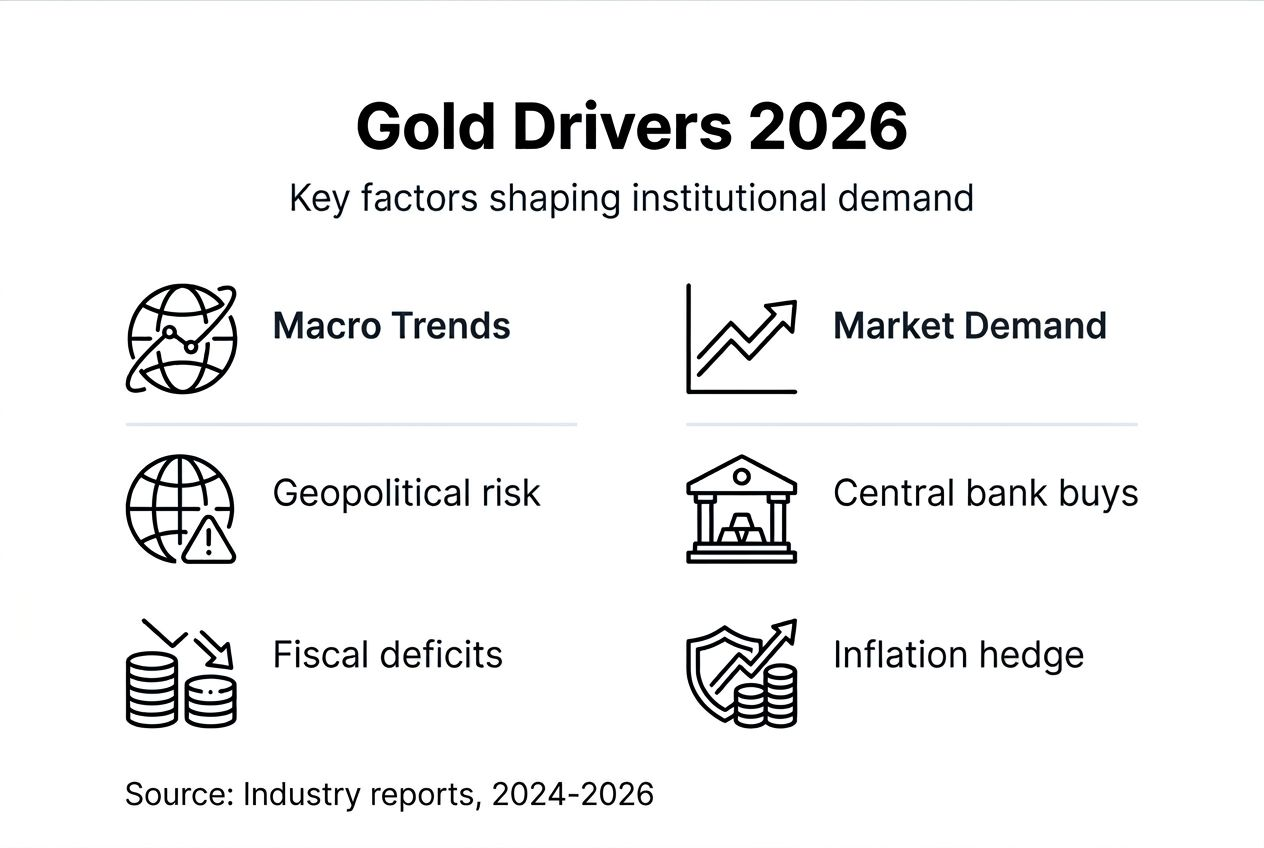
Central bank reserve diversification has accelerated. Emerging market central banks purchased over 1,000 metric tons annually from 2022 to 2025, shifting reserves away from dollar-denominated assets into gold to reduce geopolitical exposure and currency risk. This sustained official sector demand provides a structural bid supporting gold prices.
US fiscal deficits exceeding $1.5 trillion annually raise debt sustainability concerns. As government debt approaches 130% of GDP, investors question the dollar’s long-term purchasing power. Gold benefits as a non-sovereign store of value immune to fiscal mismanagement or debt monetization pressures.
De-dollarization trends compound fiscal concerns. Sanctions weaponizing the dollar system have motivated nations to explore alternative reserve assets and payment systems. Gold, with no issuer or jurisdictional dependence, emerges as a neutral asset for settling international transactions outside traditional banking channels.
Major trends favoring gold allocation in 2026:
Persistent inflation above central bank targets eroding real returns on fixed income
Geopolitical fragmentation increasing tail risk probabilities across regions
Currency volatility as major economies pursue divergent monetary policies
Technology-driven market concentration creating equity correlation risk
These drivers explain gold’s price rally from $1,800 per ounce in early 2023 to over $2,400 by mid 2025, with institutional inflows reflecting recognition of gold’s enhanced strategic value. Wealth management firms incorporating gold position portfolios to withstand macro uncertainty while maintaining growth potential through diversified equity exposure.
Practical considerations for institutional gold investment
Implementing gold allocations efficiently requires understanding operational differences, custody options, and compliance standards. Institutions must distinguish buying physical gold vs trading operations to select approaches matching investment objectives and operational capabilities.
Key differences between physical purchase and trading operations:
Physical purchase involves allocated bars in audited vaults with direct ownership and storage fees
Trading operations use futures, ETFs, or allocated accounts providing exposure without physical delivery
Physical holdings suit long-term strategic allocations with minimal turnover
Trading mechanisms offer liquidity and flexibility for tactical adjustments
Stepwise process to integrate physical gold:
Establish investment policy statement defining allocation range, rebalancing triggers, and custody standards
Select regulated platform or custodian with third-party audits, insurance, and transparent fee structures
Verify ESG compliance including responsible sourcing certifications and conflict-free supply chain documentation
Execute initial purchase through allocated accounts ensuring clear title and segregated storage
Implement ongoing monitoring for correlation changes, allocation drift, and rebalancing opportunities
Maintain documentation for regulatory reporting, audits, and fiduciary compliance
Best practices for custody and risk management:
Use allocated (not unallocated) accounts providing specific bar ownership and vault location transparency
Require annual third-party audits verifying physical inventory matches account statements
Ensure comprehensive insurance covering theft, loss, and transit risks
Diversify storage across multiple jurisdictions to mitigate political and operational risks
Maintain clear chain of custody documentation for compliance and audit trails
ESG criteria increasingly influence gold investment decisions. Institutions must verify sourcing from mines meeting environmental standards, respecting human rights, and supporting local communities. Responsible sourcing certifications like London Bullion Market Association (LBMA) Good Delivery standards provide assurance aligned with institutional ESG mandates.
Pro Tip: Select platforms emphasizing transparency and regulated operations. Choosing gold trading platforms with institutional-grade compliance, clear pricing, and robust reporting infrastructure reduces operational risk and simplifies integration with existing portfolio management systems.
Institutions exploring institutional gold investing considerations benefit from partnering with specialists offering tailored solutions, including customized allocation strategies, portfolio analytics, and integration with broader wealth management frameworks.
Strategic allocation recommendations and future outlook
Translating insights into actionable strategies requires defining allocation ranges aligned with institutional risk profiles and market outlooks. Evidence supports gold allocations between 2% and 20% depending on portfolio objectives, inflation expectations, and geopolitical risk assessments.
Recommended allocation framework:
Conservative (2% to 5%): Suitable for low-risk mandates prioritizing capital preservation with modest diversification enhancement
Moderate (5% to 10%): Balances growth and protection, optimal for most institutional portfolios seeking improved risk-adjusted returns
Aggressive (10% to 20%): Justified during high inflation or elevated geopolitical risk periods when gold’s hedging value peaks
Factors influencing future gold demand and price trends:
Continued central bank accumulation sustaining structural demand floor
Inflation persistence above 3% annually maintaining gold’s real asset appeal
Geopolitical fragmentation increasing safe haven demand during crisis episodes
Technology adoption in gold trading infrastructure improving accessibility and liquidity
Generational wealth transfer creating new investor cohorts evaluating gold allocations
Evolving portfolio construction frameworks increasingly treat gold as a core strategic holding rather than a tactical trade. Multi-asset optimization models incorporating gold demonstrate superior efficient frontier outcomes, validating permanent allocations within diversified institutional portfolios.
Continuous monitoring and dynamic adjustment remain essential. As correlations shift and macro conditions evolve, rebalancing gold within strategic ranges maintains portfolio resilience. Institutions should review allocations quarterly, adjusting based on correlation trends, inflation data, and geopolitical developments.
Gold’s role in future-proofing portfolios extends beyond near-term performance. As fiscal imbalances grow and geopolitical competition intensifies, gold provides insurance against systemic risks threatening traditional asset valuations. Understanding gold strategic allocation recommendations positions institutions to navigate uncertainty while preserving capital and maintaining growth potential.
Discover Galami Gold’s trusted solutions for institutional investors
Implementing strategic gold allocations demands partners committed to transparency, security, and institutional-grade execution. Galami Gold operates as a physical gold trading platform dedicated to disciplined operations and risk management across established supply chains.

Our platform provides institutional investors access to audited, allocated physical gold with full transparency and competitive pricing. We emphasize trust and integrity, delivering solutions aligned with fiduciary standards and ESG mandates. High ROI potential combined with robust custody and compliance infrastructure makes Galami Gold suitable for institutions seeking to enhance portfolio resilience through strategic gold allocations. Explore how investing in physical gold trading through Galami Gold integrates seamlessly with your risk management framework. Leverage our expertise in institutional gold investing considerations to implement allocations that strengthen your portfolio’s ability to withstand inflation, geopolitical shocks, and market volatility.
Frequently asked questions about gold for institutional investors
What is the ideal gold allocation percentage for institutional portfolios?
Most institutions allocate between 5% and 10% of total portfolio value to gold for balanced risk and return enhancement. Conservative mandates may hold 2% to 5%, while those anticipating elevated inflation or geopolitical instability justify 10% to 20% allocations.
How does gold provide inflation protection compared to bonds?
Gold maintains purchasing power during inflation by appreciating as currency values decline, while bond returns erode in real terms. Gold exhibits negative correlation with bonds during high inflation periods, providing protection when fixed income holdings lose value.
What custody options exist to secure physical gold for institutions?
Institutions use allocated accounts in regulated vaults with third-party audits, insurance, and clear title to specific bars. Leading custodians offer segregated storage across multiple jurisdictions, comprehensive reporting, and integration with portfolio management systems to meet fiduciary standards.
Is gold liquidity sufficient for large institutional trades?
Yes, daily global gold trading volume exceeds $150 billion across spot markets, futures, and allocated accounts. This depth enables institutions to execute multi-billion dollar positions with minimal market impact, comparable to liquidity in major equity and bond markets.
How does ESG compliance impact gold investment decisions?
Institutions require verification of responsible sourcing, including environmental standards, conflict-free supply chains, and human rights protections. Certifications like LBMA Good Delivery and third-party ESG audits ensure gold holdings align with institutional sustainability mandates and stakeholder expectations.
Recommended


Comments