


Why Gold Trading Platforms Matter for Investors
- Shannon B
- Feb 25
- 10 min read


Securing capital in precious metals presents both opportunity and complexity for institutional investors and wealth managers. Gold trading platforms have evolved into a digital ecosystem that delivers real-time market access through spot, futures, options, and CFDs. Choosing a platform now involves balancing execution speed, robust security, and transparent pricing across global markets. This overview highlights how modern platforms connect your capital efficiently while addressing compliance, risk mitigation, and operational demands unique to institutional gold investing.
Table of Contents
Key Takeaways
Point | Details |
Modern Gold Trading Platforms | Today’s platforms integrate technology, real-time data, and various instruments, facilitating more than just physical purchases of gold. |
Types of Gold Trading | Different trading methods such as spot, futures, options, and forwards serve various investor objectives and risk profiles. |
Institutional Features | Institutional platforms require high liquidity, transparent pricing, compliance infrastructure, secure custody, and global market access. |
Cost Management | Understanding cost factors like bid-ask spreads, storage fees, and commissions is vital for maximizing returns in gold trading. |
What Defines a Gold Trading Platform Today
A modern gold trading platform is far more than a simple transaction mechanism. It’s a digital ecosystem that connects institutional investors and wealth managers to global gold markets through integrated technology, real-time data, and multiple trading instruments.
These platforms deliver real-time market access through various investment vehicles. Rather than limiting you to physical bullion purchases, today’s platforms support multiple approaches:
Physical gold spot transactions and delivery
Futures and forward contracts
Options for hedging strategies
Leveraged positions via CFDs (when applicable)
What separates leading platforms from basic solutions is their infrastructure. You get technical analysis tools built directly into your trading interface, allowing you to analyze price movements, identify trends, and execute decisions without switching between multiple applications.
Speed matters enormously in gold trading. Execution velocity—the time between decision and filled order—directly impacts your entry and exit prices. A platform’s backend architecture determines whether you capture a 0.5% price move or miss it entirely while orders process.
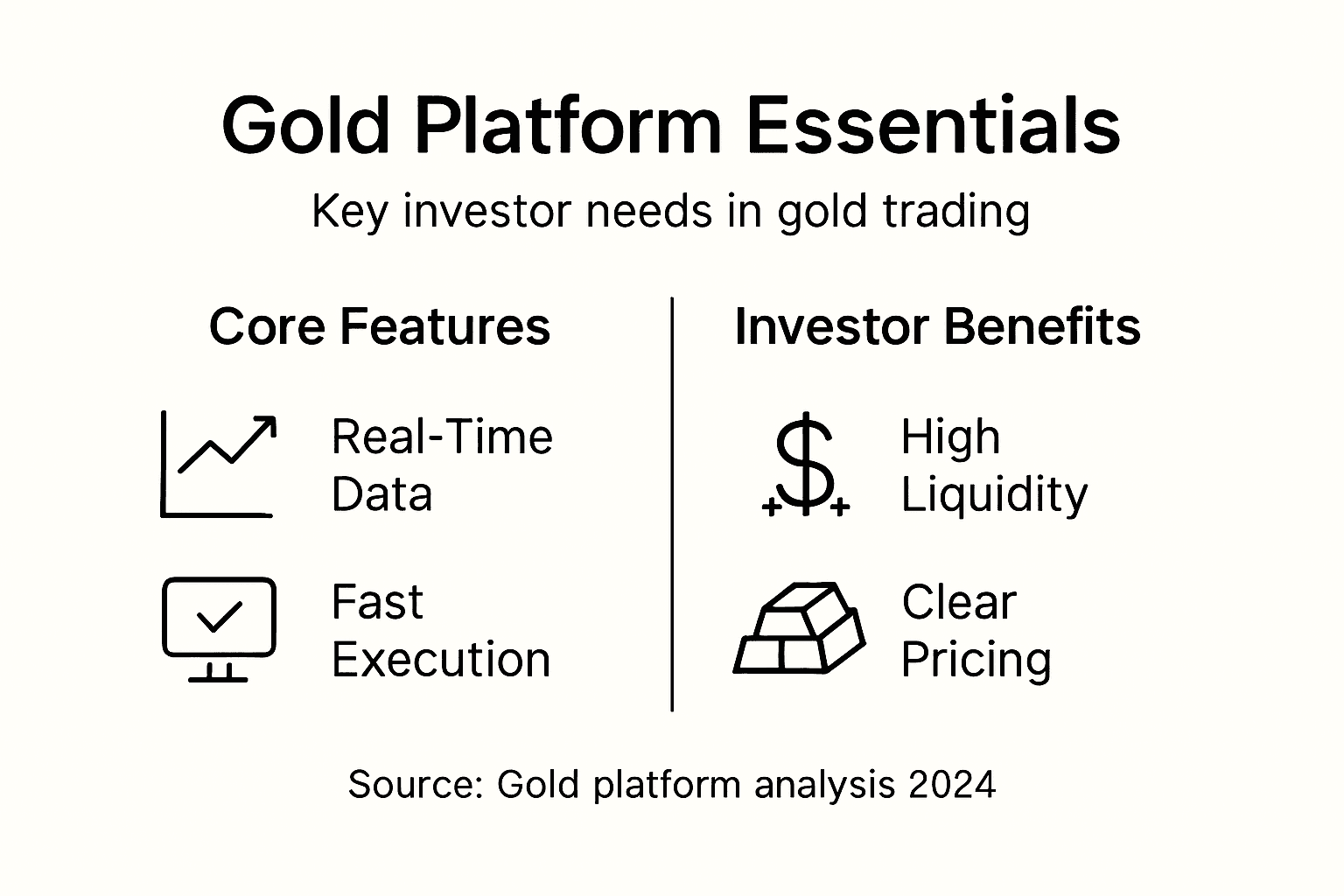
Security architecture is non-negotiable for institutions managing significant capital. Reputable platforms employ encrypted data transmission, segregated accounts, audit trails, and multi-factor authentication as standard features, not premium add-ons.
Mobility has transformed how professionals manage positions. Modern platforms offer full functionality on mobile devices, allowing you to respond to market developments during client meetings or while traveling, not just from a desktop terminal.
A gold trading platform’s true value lies not in its user interface, but in how efficiently it connects your capital to real market opportunities while protecting your operations and compliance requirements.
The shift from traditional gold dealers to digital platforms has democratized access while introducing operational complexity. You’re no longer limited by a single physical location or dealer’s inventory—but you must evaluate each platform’s liquidity, settlement procedures, and regulatory standing independently.
Pro tip: Evaluate a platform’s execution speed during low-volume market hours, not peak trading sessions—this reveals whether their infrastructure delivers consistent performance when you need it most.
Types of Gold Trading and Their Distinctions
Gold trading takes multiple forms, each serving different investor objectives and risk profiles. Understanding these distinctions is critical because they affect your capital deployment, liquidity access, and operational complexity.
The primary trading categories break down as follows:
Spot trading - Purchase or sell physical gold at current market prices with immediate settlement
Futures contracts - Standardized agreements to buy/sell gold at predetermined prices on future dates
Options - Rights (not obligations) to buy or sell gold at specified prices within defined timeframes
Forward contracts - Customized agreements between two parties for future delivery at locked-in prices
Spot trading represents the most direct approach. You’re acquiring actual physical gold or settling in cash based on real-time market prices. This works well for institutional investors building long-term reserves or those prioritizing tangible asset ownership.
Futures trading offers leverage and standardization. Instead of managing physical delivery logistics, you control larger gold quantities with fractional capital requirements. This appeals to sophisticated investors optimizing for capital efficiency and tactical positioning.
Options provide directional flexibility without the obligation to execute. You can express bullish or bearish views, hedge existing positions, or generate income through premium collection—all without committing your full capital to the underlying gold position.
Understanding the operational mechanics of physical gold trading reveals why each method carries distinct cost structures. Spot purchases involve physical handling, insurance, and storage—expenses that options and futures eliminate by operating purely on price exposure.
Each trading type serves a specific purpose in portfolio construction. Your choice depends on whether you prioritize physical ownership, capital efficiency, or tactical flexibility.
Forward contracts occupy middle ground between spot and futures. They’re customized to your exact specifications but lack the standardization and liquidity of exchange-traded futures. Institutional buyers often prefer forwards when they need specific delivery dates or quantities that futures contracts don’t accommodate.
The operational differences matter significantly. Spot trading requires secure logistics and storage oversight. Futures demand margin management and daily settlement discipline. Options require precise understanding of volatility and time decay mechanics.
Here’s a comparison of the main gold trading types and their primary use cases:
Trading Method | Key Objective | Capital Efficiency | Main Risk |
Spot Trading | Physical asset ownership | Low leverage; full payment required | Logistics and storage costs |
Futures | Capital leverage and speculation | High leverage; margin required | Margin calls and volatility |
Options | Tactical hedging; directional flexibility | Requires premium payment; limited loss | Time decay; complex pricing |
Forward Contracts | Custom delivery and pricing | Flexible terms; moderate leverage | Counterparty risk; limited liquidity |
Pro tip: Match your trading type to your investment timeline—spot positions for multi-year holdings, futures for tactical moves lasting weeks or months, and options when you’re uncertain about direction but want controlled risk.
Key Features for Institutional Investors
Institutional gold platforms differ fundamentally from retail offerings. Your requirements demand infrastructure that handles complexity, scale, and regulatory rigor that standard consumer platforms cannot support.
The foundational requirements for institutional platforms break down into several critical areas:
High liquidity - Execute large positions without slippage or market impact
Transparent pricing - Real-time quotes tied directly to global benchmarks, not proprietary spreads
Compliance infrastructure - Audit trails, KYC documentation, and regulatory reporting built into operations
Secure custody - Allocated bullion storage with independent audits and insurance coverage
Global market access - Connections to multiple trading venues and geographies
Liquidity separates institutional platforms from alternatives. You’re not trading in small increments—executing 100-ounce or larger positions requires counterparty depth and tight bid-ask spreads. Platforms lacking sufficient order flow force you to accept wider spreads, immediately eroding returns on significant capital deployment.

Transparency in pricing eliminates hidden costs. Institutions reject platforms charging undisclosed markups. Instead, you demand institutional gold investing with clearly understood costs tied to London Bullion Market Association fixes or other established benchmarks.
Compliance becomes non-negotiable. Your firm’s audit teams require detailed transaction records, counterparty documentation, and reporting compatible with your broader compliance frameworks. Platforms must integrate with your existing systems—not force you to maintain separate documentation.
Custody arrangements demand absolute clarity. You need to know exactly where your allocated bullion sits, who insures it, and how it’s audited. Commingled storage may reduce costs but introduces counterparty risk your fiduciary responsibilities cannot accept.
Risk management tools address your core concern—protecting capital while executing strategy. Platforms should offer position sizing calculators, stress testing against geopolitical scenarios, and integration with your portfolio management systems so gold positions don’t exist in isolation.
Institutional platforms succeed by reducing friction in your operations, not by adding features you don’t need.
Global market access matters because gold trading never stops. London opens first, followed by Asian markets, then New York. Your ability to respond to overnight developments requires 24-hour platform availability and consistent execution across time zones.
Pro tip: Before committing capital, stress-test the platform’s liquidity during volatile market hours—that’s when infrastructure quality reveals itself most clearly.
Regulatory Compliance and Transparency Challenges
Gold markets operate under complex, fragmented regulatory frameworks that create operational friction for institutional investors. Unlike equities or bonds, gold trading lacks a single unified standard—you navigate multiple jurisdictions, each with distinct requirements and enforcement mechanisms.
The core compliance challenges break down into several persistent issues:
Price discovery opacity - Benchmark pricing mechanisms lack real-time transparency
Cross-border reporting - Different countries demand conflicting documentation standards
Illicit trade prevention - Money laundering and sanctions evasion detection requires sophisticated screening
Supply chain traceability - Ethical sourcing verification remains fragmented
Counterparty verification - Know-your-customer requirements vary significantly by jurisdiction
Price manipulation represents the most damaging transparency problem. Historical allegations around the Goldfix process exposed how opaque price-fixing mechanisms can distort markets, harming institutional investors who depend on fair benchmarks.
Your compliance teams face contradictory requirements across jurisdictions. A transaction satisfying American regulations may violate European standards. This forces you to maintain multiple compliance frameworks instead of operating under a single coherent structure.
Anti-money laundering regulations demand rigorous counterparty screening. You cannot simply verify identification once—ongoing monitoring requires continuous assessment of client activities, source of funds, and beneficial ownership. Platforms failing to implement this infrastructure expose your firm to regulatory penalties.
Supply chain transparency creates operational complexity. Institutional investors increasingly face pressure to verify gold sourcing for ethical compliance. Tracing bullion origins through multiple dealers, refineries, and geographic transfers demands detailed documentation and third-party audits.
Regulatory compliance in gold trading isn’t optional—it’s the foundation separating legitimate operations from those exposing your firm to fines, criminal liability, and reputational damage.
Recent efforts to improve transparency focus on technology adoption and international harmonization. Blockchain-based traceability systems offer promise, though they remain unevenly implemented across suppliers. International regulatory bodies continue negotiating unified standards, but progress moves slowly.
Your platform selection must account for these challenges directly. Evaluate whether your potential trading partner invests in compliance technology, maintains updated regulatory documentation, and participates in industry standards bodies. Those cutting corners on compliance will eventually create problems for your firm.
Pro tip: Request detailed compliance documentation from any gold trading platform before committing capital—their willingness to provide complete regulatory records indicates their operational maturity.
Risk Management, Costs, and Market Impact
Gold trading demands disciplined risk management because price volatility can erode returns quickly. Unlike stable bond markets, gold responds sharply to geopolitical shocks, inflation expectations, and currency movements—sometimes swinging 5% in a single trading session.
Your risk management framework requires multiple layers:
Position sizing - Limit single trade exposure relative to total portfolio
Stop-loss protocols - Predefined exit points prevent catastrophic losses
Hedging strategies - Use futures and options to offset downside risk
Correlation monitoring - Track how gold moves relative to equities and bonds
Liquidity reserves - Maintain capital for margin calls during volatile periods
Costs directly impact net returns but remain frequently overlooked. Gold trading spreads, commissions, and storage expenses accumulate across positions, particularly when executing large institutional trades.
Bid-ask spreads vary dramatically by market conditions. During normal trading, spreads on spot gold run 0.3% to 0.5%. During crisis periods, spreads widen to 1.5% or higher, immediately reducing entry profitability and exit flexibility.
Storage costs compound over time. Allocated bullion storage runs approximately 0.25% to 0.5% annually depending on location and insurance coverage. For a $10 million position held three years, this represents $75,000 to $150,000 in direct expenses.
Commissions and platform fees vary significantly. Some platforms charge per-trade commissions while others use percentage-based models or markup spreads. Understanding your cost structure requires detailed fee analysis—hidden charges can eliminate 15% of expected returns annually.
Market impact becomes critical when executing large positions. Your $50 million gold purchase doesn’t happen at published prices—your volume affects the market price itself. Institutions typically accept 10 to 30 basis points of adverse market impact when deploying significant capital into less liquid markets.
To highlight important cost drivers in institutional gold trading, here’s a summary table:
Cost Factor | Typical Range | Business Impact |
Bid-Ask Spread | 0.3%–1.5% | Affects entry and exit prices |
Storage Fees | 0.25%–0.5% per year | Recurring annual expense |
Commissions | Fixed or percentage per trade | May reduce net returns |
Market Impact | 10-30 bps for large trades | Slippage on high volume orders |
The difference between successful gold trading and mediocre results often comes down to disciplined cost management and realistic assumptions about market impact.
Hedging using risk management strategies with futures and options protects against sharp downside movements while preserving upside participation. A protective put limits losses to your premium paid while maintaining unlimited gains. Collar strategies balance protection costs against limited upside.
Liquidity fluctuations demand constant attention. Gold markets show strong liquidity during London and New York hours but weaken significantly during Asian overnight sessions. Your platform should provide real-time liquidity indicators and execution speed confirmation.
Pro tip: Calculate your true all-in cost per ounce including spreads, commissions, storage, and insurance before deploying capital—this reveals whether your expected returns justify the trading activity.
Discover How Reliable Gold Trading Platforms Protect Your Investment
Navigating gold trading today requires more than quick execution and price tracking. The article highlights key challenges such as security, transparency, regulatory compliance, and managing market impact that sophisticated investors face daily. If you value disciplined execution, transparent pricing, and robust risk management built on trust and integrity, Galami Gold provides a proven solution tailored for institutional needs.

Explore how Galami Gold connects you directly to physical gold markets with secure custody and clear audit trails. Our platform addresses the critical pain points discussed by offering seamless integration with well-established supply chains and rigorous compliance measures. Don’t let operational complexity and hidden costs diminish your capital efficiency. Visit Galami Gold trading platform today to learn how we help you confidently execute gold strategies designed around your specific objectives. Take the next step in elevating your gold investment approach by reviewing our strategic approach and understanding the operational mechanics of physical gold trading. Your portfolio deserves a platform that puts transparency and security first.
Frequently Asked Questions
What are the primary types of gold trading methods?
The main gold trading methods include spot trading, futures contracts, options, and forward contracts. Each serves different investor objectives such as physical asset ownership, capital leverage, or tactical flexibility.
How do gold trading platforms ensure security for investors?
Reputable gold trading platforms implement security measures like encrypted data transmission, segregated accounts, audit trails, and multi-factor authentication to protect investors’ capital and sensitive information.
What key features should institutional investors look for in a gold trading platform?
Institutional investors should prioritize high liquidity, transparent pricing, compliance infrastructure, secure custody arrangements, and global market access when selecting a gold trading platform.
Why is risk management important in gold trading?
Risk management is crucial in gold trading due to the market’s price volatility. Implementing strategies like position sizing, stop-loss protocols, and hedging helps protect capital and ensures more stable investment outcomes.
Recommended


Comments